
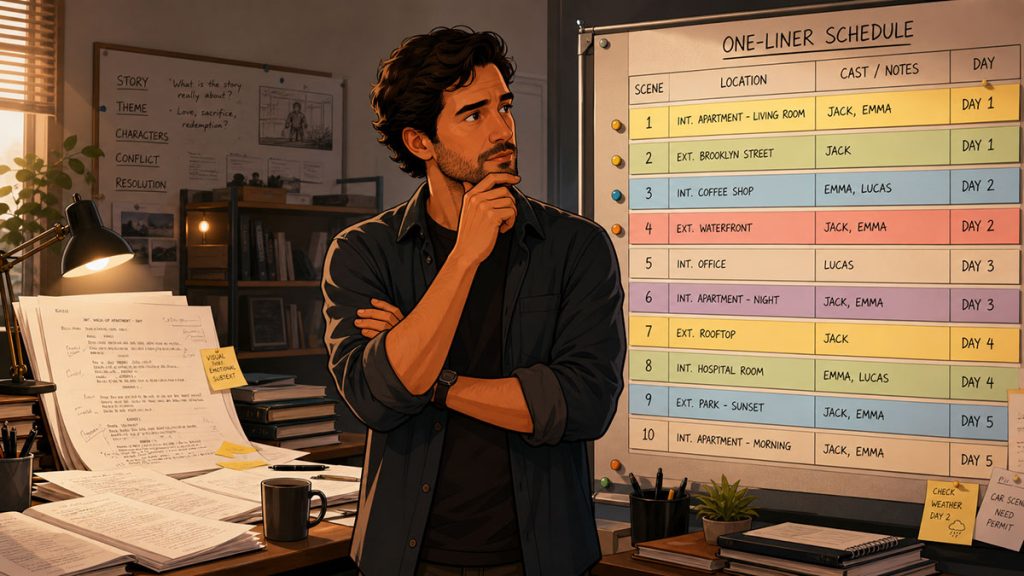
A filmmaker’s guide to turning a screenplay into a shootable plan
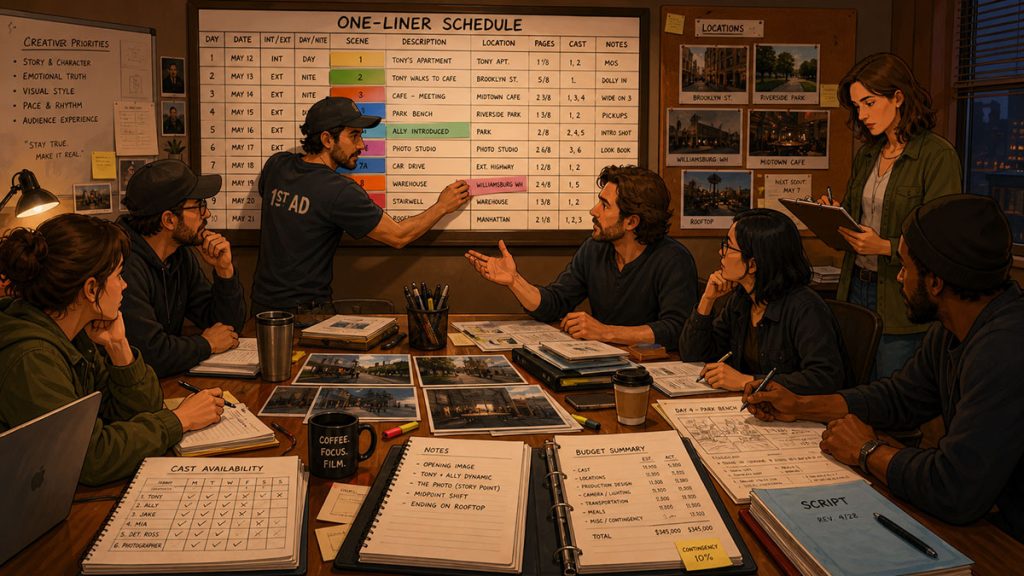
Every film starts as words on a page. But before those words become camera setups, call sheets, crew moves, actor schedules, meal breaks, and long days on set, they have to pass through one of the most important documents in pre-production: the one-liner schedule.
A one-liner schedule is where the screenplay begins to transform from a creative document into a practical production plan.
It does not show every detail of the shoot. It does not replace the full shooting schedule. It is not the call sheet. Instead, the one-liner gives producers, assistant directors, department heads, and filmmakers a clean bird’s-eye view of how the production is expected to unfold.
For beginner filmmakers, this document can feel mysterious at first. For experienced producers and assistant directors, it is one of the fastest ways to understand whether a schedule makes sense, where the pressure points are, and how a production is likely to affect the budget.
In other words, the one-liner is the production’s early map. Not the whole jungle, but enough of the trail to know where the snakes, cliffs, and expensive company moves might be hiding.
What Is a One-Liner Schedule?
A one-liner schedule is a condensed version of a film production schedule that lists each scene or strip of production information in a simplified, easy-to-read format.
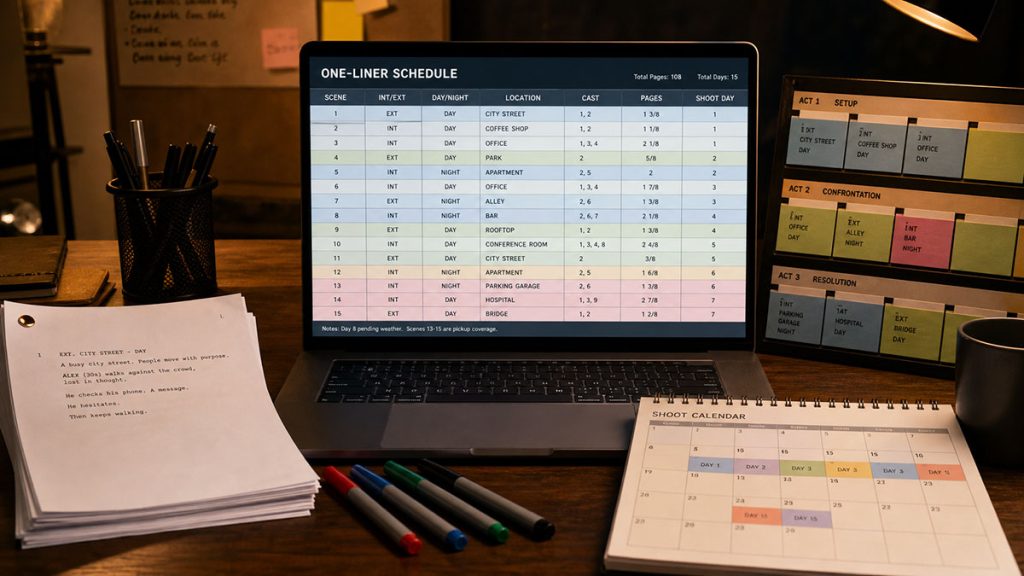
It is called a “one-liner” because each scene is typically represented on a single line. That line usually includes the essential scheduling information needed to understand what is being shot, when it is being shot, where it takes place, and who is needed.
A one-liner schedule commonly includes:
Scene number
Interior or exterior
Day or night
Scene description
Script page count
Location
Cast involved
Shoot day
Special elements such as stunts, vehicles, animals, visual effects, or background actors
The exact format may vary depending on the production, the assistant director, or the scheduling software being used, but the purpose is always the same: to provide a clear overview of the production schedule without overwhelming everyone with excessive detail.
A one-liner is especially useful because it lets the team see the shape of the shoot quickly. You can glance at it and understand how scenes are grouped, how locations are being handled, which cast members are working on specific days, and where the schedule may be too ambitious.
Why the One-Liner Schedule Matters
The one-liner schedule matters because filmmaking is a puzzle made out of time, money, people, places, and creative ambition.
A screenplay may read beautifully in order. Scene 1 leads to Scene 2, which leads to Scene 3. But films are rarely shot in script order. Productions are usually scheduled based on practical factors: location availability, actor availability, day versus night work, company moves, special equipment, weather, and budget limitations.
The one-liner schedule helps bring those factors into view.
For example, a script might have five scenes that take place in the same apartment, but those scenes may be scattered across the screenplay. The one-liner helps the assistant director group those scenes together so the production can shoot them efficiently while the location, set dressing, lighting, and actors are already in place.
That one decision can save hours, sometimes days.
The one-liner also helps producers see the relationship between creative choices and production cost. If the schedule shows multiple night exteriors, several distant locations, or scenes involving many background actors, the production team can immediately start asking the right questions:
Can these scenes be combined?
Can this location double for another location?
Can this be rewritten to reduce a company move?
Is this shoot day too heavy?
Are we creating overtime risk?
That is why the one-liner schedule is not just an organizational document. It is a decision-making tool.
What Information Is Included in a One-Liner Schedule?
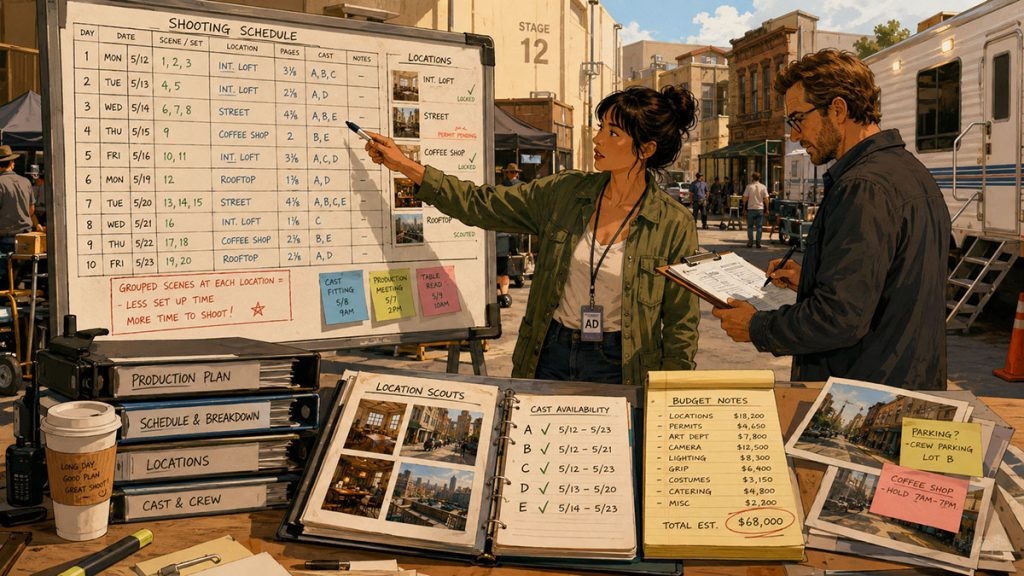
A one-liner schedule is designed to be simple, but the information inside it is carefully chosen. Each line gives the team just enough detail to understand what the scene requires.
A typical one-liner schedule may include the following elements.
Scene Number
The scene number connects the schedule back to the screenplay. This is essential because everyone needs to know which part of the script is being discussed.
If the director asks, “When are we shooting Scene 23?” the one-liner gives the answer quickly.
Script Day or Story Day
Some schedules include the story day, especially if continuity is important. A film may shoot Scene 40 before Scene 5, but the character’s wardrobe, makeup, injuries, props, and emotional state must still match the story timeline.
This helps wardrobe, makeup, props, and continuity departments track what needs to appear on screen.
INT./EXT. and DAY/NIGHT
The one-liner will usually identify whether a scene is interior or exterior and whether it takes place during the day or night.
This matters because day and night scenes affect lighting, crew hours, location access, and production complexity. A night exterior on a remote street is very different from a daytime interior scene in a controlled office.
Scene Description
The scene description gives a short summary of the scene. It does not need to explain the entire dramatic purpose. It simply identifies the action clearly enough for the production team.
For example:
“Sarah confronts David in the hallway.”
That one line gives the team enough context without turning the schedule into a script summary.
Page Count
The page count tells the team how much script material is being scheduled. A production might shoot three pages in one day, six pages in one day, or half a page in one day depending on complexity.
Page count is one of the first things producers and assistant directors use to judge whether a shoot day is realistic.
But page count can be deceptive. Two pages of simple dialogue may be very manageable. Half a page of car chase, rain effects, background actors, and stunt coordination may devour the day like a hungry production goblin.
Location
The one-liner identifies where each scene is being shot. This is one of the most important pieces of scheduling information because locations often drive the structure of the schedule.
Grouping scenes by location is one of the most common ways to make a schedule more efficient.
Cast
The one-liner often lists which cast members are needed for each scene. This helps production track actor work days, conflicts, pickups, and availability.
This information is also closely connected to the Day Out of Days report, which shows when each actor works, starts, finishes, holds, or travels during the production.
Special Elements
Some one-liners also flag special production requirements, such as:
Stunts
Vehicles
Weapons
Animals
Special effects
Visual effects
Background actors
Children
Crowd scenes
Practical effects
Drones
Special equipment
Water work
Period costumes
These details matter because special elements often affect time, crew, safety, permits, insurance, and budget.
One-Liner Schedule vs. Shooting Schedule
A one-liner schedule and a shooting schedule are closely related, but they are not always the same thing.
The shooting schedule is the complete production plan that organizes what will be filmed on each day. It may contain more detail, more department-specific notes, and more logistical information.
The one-liner schedule is a simplified version of that schedule. It gives the essential overview without every extra layer of detail.
Think of it this way:
The shooting schedule is the full blueprint.
The one-liner is the clean production roadmap.
The one-liner is often easier to share with producers, directors, department heads, investors, or anyone who needs to understand the plan without getting buried in scheduling minutiae.
It is especially useful in early pre-production, when the schedule is still being adjusted. The team can review the one-liner, discuss problem areas, and make changes before more detailed planning begins.
One-Liner Schedule vs. Stripboard
The one-liner schedule is also connected to the stripboard.
Traditionally, scenes were written or printed on strips and placed on a production board. Each strip represented a scene, and assistant directors could physically move scenes around to build the schedule. This allowed the team to group scenes by location, cast, time of day, or production needs.
Modern scheduling software works the same way digitally.
The stripboard is where the schedule is built and rearranged. The one-liner is often the readable report that comes out of that scheduling process.
For example, an assistant director may move scenes around on the stripboard to reduce company moves. Once the schedule is organized, the one-liner can be generated and shared with the production team.
The stripboard is the workshop.
The one-liner is the polished map.
Who Uses the One-Liner Schedule?
The one-liner schedule is useful across many departments.
For the assistant director, it is a core planning tool. The AD uses it to organize scenes, structure shoot days, identify logistical issues, and communicate the schedule clearly.
For the producer, it helps reveal how the schedule affects the budget. If the one-liner shows too many locations, heavy night work, or scattered cast days, those issues can turn into real costs.
For the director, the one-liner gives a practical view of when scenes will be shot and how creative priorities fit into the production plan.
For department heads, it helps anticipate what is needed and when. Camera, lighting, art department, wardrobe, makeup, props, sound, transportation, and locations can all use the one-liner to prepare.
For actors, it helps clarify when they are expected to work, though actors usually receive more immediate details from call sheets.
For independent filmmakers, the one-liner is especially valuable because smaller productions often have less margin for error. When you have limited money, limited days, and limited crew, a clear schedule becomes even more important.
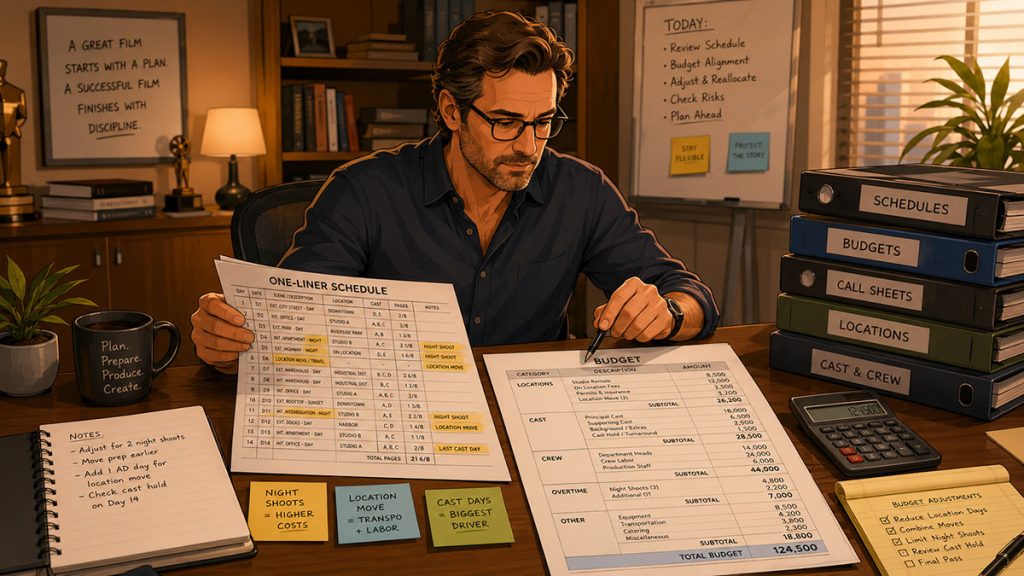
How a One-Liner Schedule Helps Control the Budget
A one-liner schedule may look like a scheduling document, but it has a direct impact on the budget.
Every scheduling decision has a cost. A company move costs time. A night shoot can increase labor pressure. A location that requires permits, security, or special equipment can change the budget. A scene with background actors, vehicles, or special effects may require more crew and more prep.
The one-liner helps producers identify these cost drivers early.
For example, if the one-liner shows that a lead actor works one day, then has three days off, then comes back for one small scene, that may create unnecessary hold days, travel issues, or availability problems.
If several scenes take place in the same location but are spread across multiple shoot days, the production may be paying for the same location more than necessary.
If one shoot day contains too many difficult scenes, the production may be creating overtime risk before the camera even rolls.
This is where scheduling and budgeting become inseparable. The one-liner gives the team a practical way to spot problems before they become expensive problems.
When Should You Create a One-Liner Schedule?
A one-liner schedule is usually created after the script breakdown has begun and the production team has enough information to start organizing the shoot.
The basic workflow often looks like this:
The screenplay is finalized or close to finalized.
The script is broken down into scenes and production elements.
Each scene is placed on strips or inside scheduling software.
The assistant director or producer begins arranging scenes into shoot days.
The one-liner schedule is generated and reviewed.
The schedule is revised as creative and logistical factors change.
The earlier you create a rough one-liner, the earlier you can identify problems.
This is especially helpful during budgeting. A producer can look at an early one-liner and begin estimating how many shoot days are needed, how many locations are involved, how many cast work days are required, and where the production may need more resources.
A one-liner does not have to be perfect at the beginning. It just needs to be useful.
Pre-production is often about replacing vague anxiety with specific problems. A one-liner schedule does exactly that.
One-Liner Schedule Example
A simplified one-liner entry might look something like this:
Scene 12 | INT. APARTMENT | NIGHT | Sarah confronts David | 2 1/8 pages | Cast: Sarah, David | Location: Apartment | Shoot Day 4
From this one line, the team can quickly understand:
The scene number
The setting
The time of day
The basic action
The page count
The cast needed
The location
The planned shoot day
A full one-liner schedule repeats this structure across the entire project, giving the production team a complete overview of the shoot.
For larger productions, the report may include more columns. For smaller productions, it may be simpler. The goal is not to make the document complicated. The goal is to make the production understandable.
Practical Tips for Building a Better One-Liner Schedule
A strong one-liner schedule begins with a strong script breakdown. If the breakdown misses important details, the schedule will inherit those problems.
Pay close attention to locations. Grouping scenes by location is one of the most effective ways to save time and money.
Track day and night work carefully. Too many night shoots in a row can be difficult on cast and crew, and switching between day and night work can affect turnaround and morale.
Watch for small scenes that carry big production weight. A scene may be only half a page, but if it involves a crowd, stunt, vehicle, or special effect, it deserves serious attention.
Review cast work days early. Efficient cast scheduling can reduce unnecessary holds, travel complications, and availability conflicts.
Use the one-liner as a conversation tool. The best schedules are built through collaboration between the assistant director, producer, director, locations, and department heads.
Most importantly, do not treat the first version as sacred. Schedules are living documents. A good one-liner is meant to be reviewed, challenged, and improved.
Final Thoughts
A one-liner schedule is one of the most useful documents in film pre-production because it helps filmmakers see the entire shoot in a clear, practical format.
It turns the screenplay into a plan. It helps the assistant director organize shoot days. It helps the producer understand budget pressure. It helps department heads prepare. It helps the director see how creative priorities fit inside real-world production limits.
For beginner filmmakers, learning how to read and use a one-liner schedule is a major step toward understanding how films actually get made.
Because filmmaking is not just about having a great idea. It is about building a plan strong enough to carry that idea through long days, limited resources, shifting locations, and the glorious controlled chaos of production.
A good one-liner does not make the movie for you.
But it does give the movie a fighting chance.
Ready to turn your screenplay into a production-ready schedule?
Gorilla Scheduling helps filmmakers break down scripts, organize scenes, build stripboards, and generate professional reports like one-liner schedules. Whether you are planning an indie feature, short film, commercial, or student production, Gorilla Scheduling gives you a clearer path from script to set.
Explore Gorilla Scheduling and start building your film schedule with confidence.
Continue Learning Film Production Planning
If you’re diving deeper into production planning, understanding how stripboards connect to scheduling and budgeting is essential.
You may also find these guides helpful:
- How to Schedule a Film Shoot
- Film Budget Template (Free Guide)
- What is a Stripboard and How to Create one
- How to Write a Filmable Screenplay
- What Is a Call Sheet in Film? (Free Download)
- What Is a Crew Deal Memo (And Why It Can Save Your Production)
- Film Budget Categories Explained
- How a Shooting Schedule Impacts Your Film Budget
- What Is a Production Strip in Film Scheduling?
- How to Turn a Script Breakdown Into a Film Budget
Together, these form the foundation of an efficient, well-organized production.
Questions or Comments?
Have a question about stripboards or film scheduling? Feel free to leave a comment below — or reach out if you want to learn more about how professional tools can streamline your workflow.