✍️ Introduction
Before a single frame is shot… before the first call sheet goes out… before the crew steps onto set…
There’s one document that quietly determines how smoothly your production will run:
The crew deal memo.
It’s not flashy.
It’s not creative.
But it’s one of the most important documents in your entire production workflow.
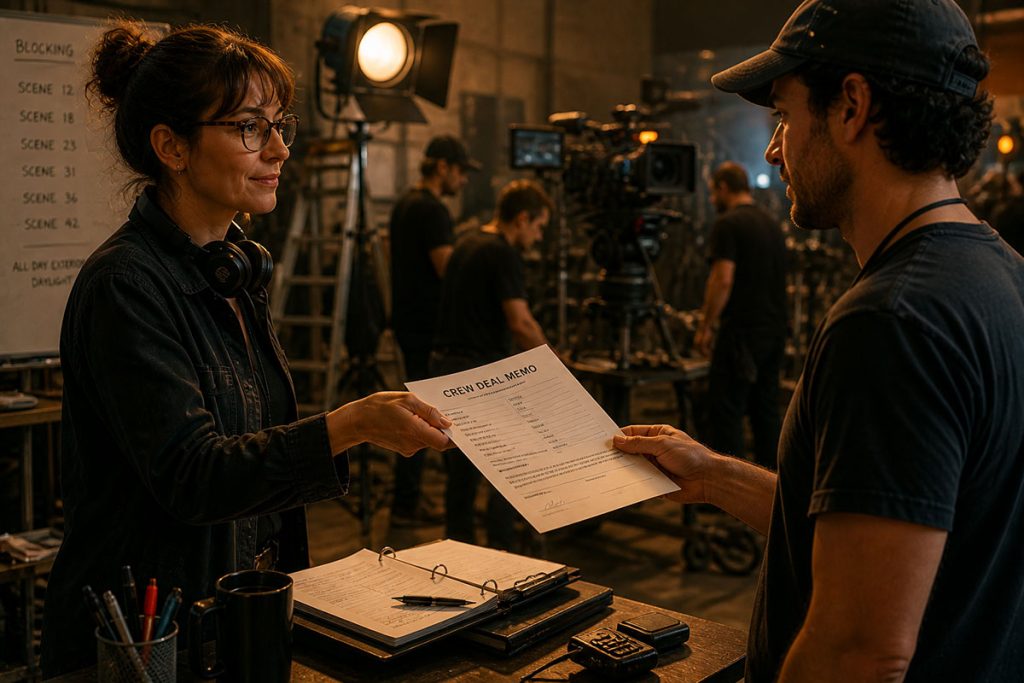
At its core, a crew deal memo is an agreement between the production company and each crew member that outlines the terms of their employment—things like rate, schedule, responsibilities, and expectations.
Yes, we have one here you can download as a template! But read on — understand what it’s all about — and we have another option for a more refined Crew Deal Memo option if you also need film scheduling…
And while it may look simple on the surface, it plays a critical role in protecting your production from confusion, disputes, and unexpected costs.
Because without it… you’re relying on memory, assumptions, and verbal agreements.
And those don’t hold up well under pressure.
What Is a Crew Deal Memo?
A crew deal memo is a short-form agreement that defines the working relationship between a production and a crew member.
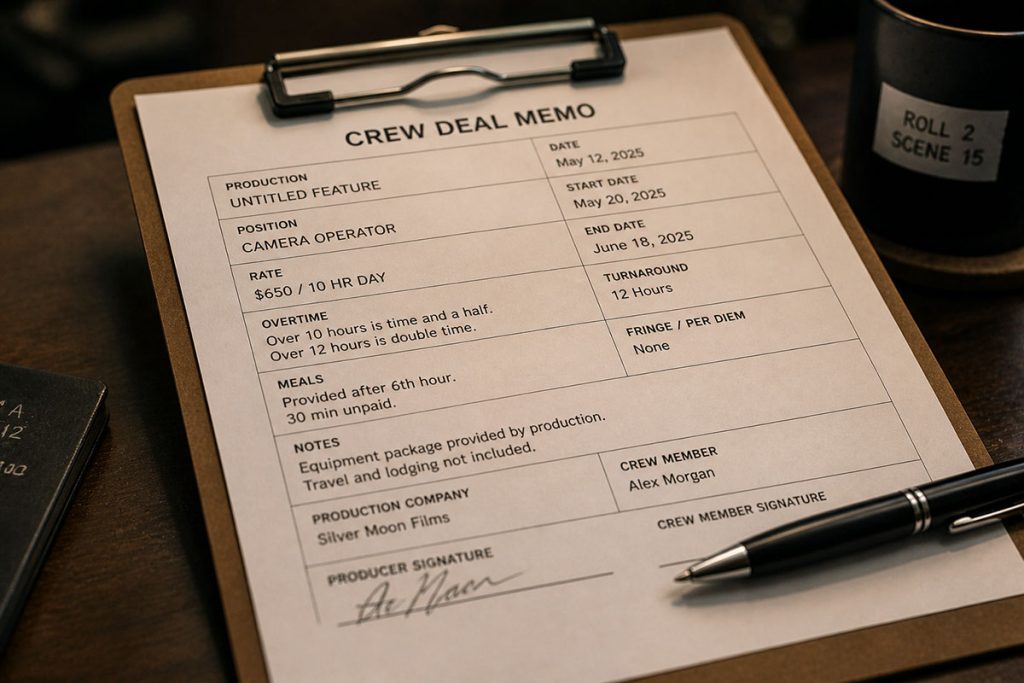
It typically includes key details like:
- Rate of pay (daily, weekly, or flat)
- Start and end dates
- Job title and responsibilities
- Working conditions
- Credit
- Overtime, meals, and turnaround expectations
Unlike a long-form contract, a deal memo is designed for speed. It allows productions to hire crew quickly while still putting essential terms in writing.
But make no mistake—once signed, it carries real weight.
In most productions, especially independent films, the deal memo becomes the primary governing document for that crew member’s employment.
Why Crew Deal Memos Matter More Than You Think
Most production problems don’t start on set.
They start before production… when expectations are unclear.
A crew deal memo eliminates that ambiguity.
It ensures:
- Everyone agrees on pay
- Everyone understands their role
- Everyone knows the schedule
- Everyone is working under the same expectations
Without that clarity, small misunderstandings can turn into real problems.
A crew member might expect a higher rate.
Someone assumes meals are included when they’re not.
Overtime rules were never clearly defined.
These issues rarely show up on Day 1.
They show up later—when the production is already under pressure.
And at that point, they’re harder (and more expensive) to fix.
From a production standpoint, deal memos do something even more important:
They protect the budget.
Because once terms are agreed upon in writing, you eliminate surprises. And in filmmaking, surprises are almost always expensive.
Why Crew Deal Memos Matter More Than You Think
Most production problems don’t start on set.
They start before production… when expectations are unclear.
A crew deal memo eliminates that ambiguity.
It ensures:
- Everyone agrees on pay
- Everyone understands their role
- Everyone knows the schedule
- Everyone is working under the same expectations
Without that clarity, small misunderstandings can turn into real problems.
A crew member might expect a higher rate.
Someone assumes meals are included when they’re not.
Overtime rules were never clearly defined.
These issues rarely show up on Day 1.
They show up later—when the production is already under pressure.
And at that point, they’re harder (and more expensive) to fix.
From a production standpoint, deal memos do something even more important:
They protect the budget.
Because once terms are agreed upon in writing, you eliminate surprises. And in filmmaking, surprises are almost always expensive.
What Should Be Included in a Crew Deal Memo?
Section Body
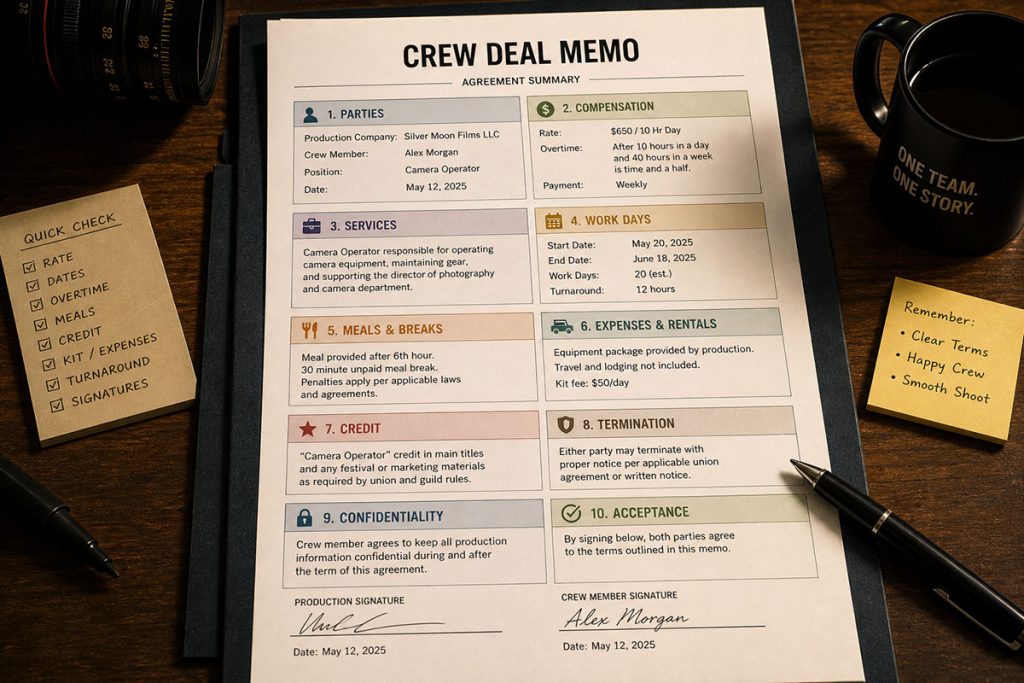
While every production is different, most crew deal memos include a consistent set of core elements.
At a minimum, your deal memo should clearly define:
1. The Parties
Who is hiring, and who is being hired.
2. Compensation
Daily rate, weekly rate, or flat fee, along with any overtime provisions.
3. Services
The role and responsibilities of the crew member.
4. Work Schedule
Expected workdays, hours, and turnaround time between shoot days.
5. Meals and Breaks
Meal timing and penalties (especially critical on union shoots).
6. Expenses and Rentals
Reimbursements, kit fees, and equipment usage.
7. Credit
How the crew member will be credited in the final production.
8. Termination Terms
Conditions under which the agreement can be ended.
9. Confidentiality
Protection of the project’s creative and business information.
These sections form the backbone of the agreement and ensure that both sides understand exactly what they’re committing to.
How Deal Memos Connect to Your Schedule and Budget
Here’s where this ties directly into your content ecosystem.
A crew deal memo is not just a legal document.
It’s a budget document.
Every rate listed in a deal memo must align with your budget.
Every workday defined in the memo must align with your schedule.
If those elements fall out of sync, problems appear fast.
For example:
- If a rate is higher than budgeted → costs increase
- If workdays extend beyond the schedule → labor costs expand
- If overtime isn’t planned → expenses spike
This is why deal memos are not just paperwork.
They are where your schedule and budget become real commitments.
How Tools Like Gorilla Help Manage Deal Memos
Managing deal memos manually works… until it doesn’t. Wouldn’t it be just great if you could click on a crew name and wala! their Crew Deal Memo appears! You can then modify the agreement if needed and then save a PDF, print it, or even e-mail it directly to the crew member!
With Gorilla Scheduling, Crew Deal Memos are built right into the software… because:
As your production grows, you’re dealing with:
- Dozens (or hundreds) of crew members
- Multiple rates and deal structures
- Constant schedule changes
- Budget adjustments
At that point, tracking everything across spreadsheets and documents becomes risky.
This is where tools like Gorilla come into play.
Because when your scheduling and budgeting are already connected, deal memos naturally become part of that system.
Rates stay aligned with the budget.
Schedules reflect actual crew commitments.
Changes can be tracked before they become problems.
Instead of reacting to issues during production, you’re preventing them during pre-production.
Conclusion
A crew deal memo may not be the most exciting part of filmmaking.
But it is one of the most important.
It sets expectations.
It protects your production.
It keeps your schedule and budget aligned.
And most importantly, it ensures that everyone starts on the same page—before the cameras roll.
Continue Learning Film Production Planning
If you’re diving deeper into production planning, understanding how stripboards connect to scheduling and budgeting is essential.
You may also find these guides helpful:
- How to Schedule a Film Shoot
- Film Budget Template (Free Guide)
- What is a Stripboard and How to Create one
- What is a Call Sheet and How to Create one
- What is a Stripboard?
Together, these form the foundation of an efficient, well-organized production.
Questions or Comments?
Have a question about stripboards or film scheduling? Feel free to leave a comment below — or reach out if you want to learn more about how professional tools can streamline your workflow.