
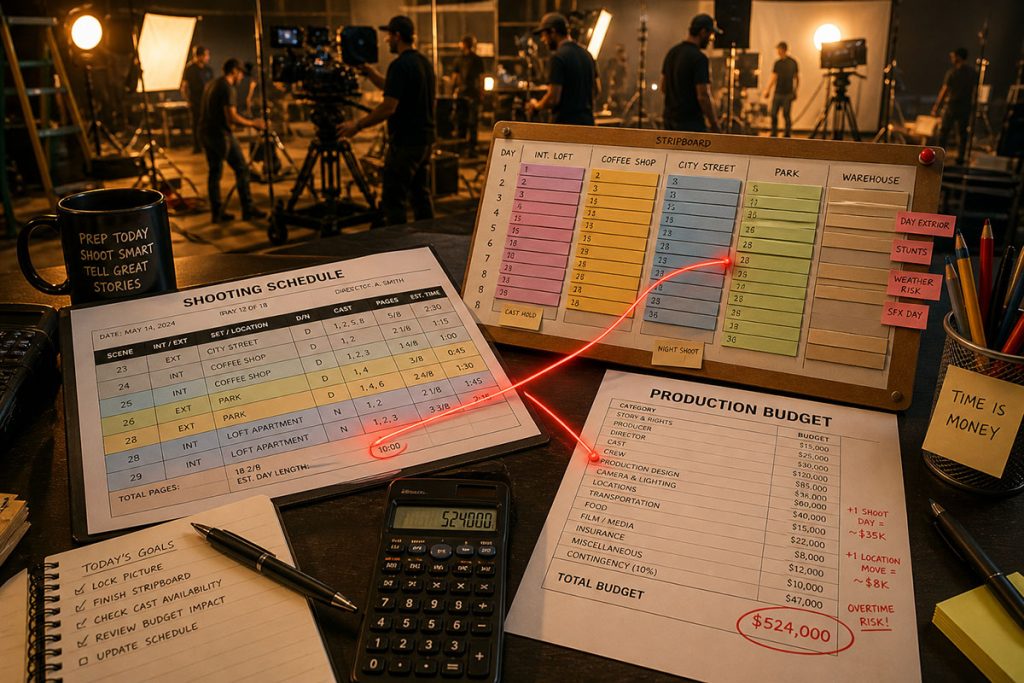
The Shooting Schedule
Understanding your film schedule and budget is one of the most important skills a filmmaker can develop…
A film schedule is never just a calendar.
It acts as one of the most important financial documents in your entire production.
Every decision within the schedule affects the budget in some way. The number of shoot days, the order of scenes, the way locations are grouped, the availability of actors, the timing of equipment rentals, and even the placement of meal breaks all shape how much a production ultimately costs.
For that reason, professional productions rarely treat scheduling and budgeting as separate tasks. From the beginning, they build them together — and that is why the shooting schedule is probably one of the most important documents in your production.
The Script Breakdown
A script breakdown defines what the production needs. The shooting schedule determines when those elements are required. The budget translates those choices into real costs.
When these three pieces align, the production stays organized, realistic, and financially grounded. When they drift apart, problems begin to surface quickly.
A scene that appears simple on the page may require a specific location, multiple cast members, picture vehicles, special props, extras, night work, and additional crew. Poor scheduling can turn that single scene into a chain reaction—extra company moves, overtime, extended rentals, or actor conflicts. One small decision can ripple across the entire budget.
For independent filmmakers, this relationship becomes even more critical. Studio productions may absorb inefficiencies, but smaller productions rarely have that luxury. One poorly planned day can eat into contingency. One unnecessary move can reduce coverage time. One added shoot day can affect crew costs, gear rentals, insurance, meals, transportation, and post-production reserves.
Perfection is not the goal. No schedule survives production untouched. Weather shifts. Actors get sick. Locations fall through. Scenes take longer than expected.
However, a strong schedule creates control before chaos arrives.
Time is Money… and Money is Time…
The real objective is not to build a schedule that looks clean on paper. The goal is to build one that understands the budget behind it.
A good schedule asks practical questions early:
How many days can we realistically afford?
Are scenes grouped in a way that saves time?
Are we creating hidden overtime risks?
Are we using cast, locations, and equipment efficiently?
Do our creative choices align with the budget?
At this point, scheduling becomes more than logistics. It becomes strategy.
Filmmakers who understand the relationship between schedule and budget make stronger decisions earlier. They spot expensive problems before they happen. They protect the production from avoidable waste. Most importantly, they give the director and crew the best possible conditions to do their work.
Because on a film set, time does not just pass.
It accumulates cost.
Crew labor. Equipment rental. Location access. Meals, transportation, insurance, and overtime.
Time shows up everywhere… wearing a headset and holding a walkie.
The Hidden Link Between Your Film Schedule and Budget

On paper, a film schedule looks harmless.
Rows, columns, scene numbers, and neatly stacked strips suggest control. Everything appears organized and manageable.
Underneath that structure, however, something more powerful is happening.
The schedule is not just organizing time. It is actively allocating money.
Every minute on set carries a cost. Crew members remain on the clock. Equipment runs on rental periods. Locations operate within fixed windows. Meals must be served. Transportation continues moving. Insurance quietly ticks in the background.
Time does not pass freely on a film set. It generates expense — hence Time is Money and Money is Time…
This is where many early productions run into trouble. A common assumption is that fewer shoot days automatically mean savings. Sometimes that works. Other times, compressing a schedule creates hidden costs that are far more damaging.
Consider a 10-hour day that stretches into 14 hours. Those extra hours trigger overtime rates across departments. Fatigue slows down the crew. Mistakes increase. Efficiency drops. The following day often starts behind schedule, creating a chain reaction.
Stretching a schedule can also create problems. More days mean more wages, longer equipment rentals, additional catering, transportation, and housing costs. What feels like breathing room can turn into a slow financial leak.
So the real question is not:
How many days should we shoot?
A better question is:
How do we design each day to use time efficiently?
Experienced Assistant Directors approach scheduling from this perspective. Instead of viewing the schedule as a checklist of scenes, they treat it as a system.
They consider setup time, company moves, cast logistics, and crew capacity. They evaluate whether the pace of the day supports efficiency or quietly undermines it.
A well-constructed schedule respects the natural rhythm of production. It balances setup, execution, and adjustment without pushing the crew into constant recovery mode.
That shift in thinking changes everything.
You are not just scheduling scenes.
You are shaping how money moves through the production.
Smart decisions reduce pressure and stabilize costs. Poor decisions introduce friction. On a film set, friction almost always turns into expense.
That is why professionals focus on details that may seem minor. Moving a scene from one day to another. Adjusting a call time. Regrouping locations. Each choice carries financial consequences.
Time does not simply move forward.
It converts.
Where Scheduling Decisions Affect Your Budget
Once the connection between time and money becomes clear, the next step is identifying where that relationship shows up in real decisions.
Budget problems rarely come from a single catastrophic mistake.
More often, they develop through a series of small choices that compound over time.
A scene shifts to accommodate an actor.
A location spreads across multiple days.
A company move gets added to make the schedule work.
Each decision carries a cost, whether it is obvious or not.
The difference between a well-run production and a struggling one often comes down to awareness. Strong teams recognize these pressure points while building the schedule. Weaker ones discover them during production, when options are limited.
Understanding where these costs originate allows filmmakers to stay ahead of them.
Location Grouping and Company Moves
One of the fastest ways to lose both time and money on set is through unnecessary company moves.
On paper, moving locations can feel like a simple transition. In reality, it is one of the most disruptive and expensive events in a shoot day.
The moment you move, everything resets.
Lighting setups come down and have to be rebuilt.
Camera and grip equipment must be packed, transported, and reassembled.
Crew members shift focus from execution to logistics.
Momentum disappears.
And most importantly, the clock does not stop.
You are still paying your crew while no footage is being captured.
This is why experienced Assistant Directors prioritize grouping scenes by location as aggressively as possible during scheduling. Even if scenes are written far apart in the script, shooting them together can dramatically reduce wasted time.
A well-grouped schedule might feel less intuitive from a storytelling perspective, but production is not shot in story order. It is shot in the order that makes the most logistical and financial sense.
Saving even one company move in a day can be the difference between finishing on time and slipping into overtime.
And overtime, once triggered, rarely stays contained.
Shoot Day Design and Overtime Risk
“Not All Scenes Are Create Equal!” said the Scheduling God…
Two schedules may both say “10 shoot days,” but the actual cost of those days can be wildly different depending on how they are structured.
A day that looks efficient on paper can quietly become expensive if it pushes the crew beyond realistic limits.

Example:
Scene 1: INT. COFFEE SHOP – DAY
Harry and Sally sit in a booth eating lunch.
VS.
Scene 2: EXT. ROME STREET – DAY
James Bond is being chased by a helipcoter.
One line of action for each scene… but man are they different!
Scenes that require multiple setups, complex blocking, special effects, or large cast coordination take time. If too many of those elements are stacked into a single day, the schedule becomes fragile.
All it takes is one delay—a late actor, a lighting issue, a performance that needs more takes—and the day begins to stretch.
Once you cross into overtime, costs escalate quickly. Crew rates increase. Departments slow down due to fatigue. Decision-making becomes less sharp. Small mistakes begin to appear, and those mistakes often cost time to fix.
What looked like an efficient day turns into an expensive one.
Strong scheduling anticipates this.
Instead of asking, “How much can we fit into this day?”
It asks, “What can we realistically accomplish without triggering overtime?”
There is a rhythm to a good shoot day. It has flow. It allows for setup, execution, and adjustment without constantly racing the clock.
When that rhythm is respected, the production stays efficient. When it is ignored, the budget starts absorbing the consequences.
Cast Availability and Holding Costs
Actors introduce another layer of complexity that directly affects both schedule and budget.
Unlike locations or equipment, cast availability is often fixed. Their schedules may be limited, especially if they are working on multiple projects or have contractual constraints.
If the schedule does not group their scenes efficiently, the production can end up paying for days when the actor is technically “on hold” but not actively working.
Those hold days add up quickly.
In some cases, productions are forced to schedule around a key actor’s availability in ways that create inefficiencies elsewhere—splitting locations, increasing company moves, or extending the shoot.
This is where scheduling becomes a balancing act.
You are not just optimizing for locations or time.
You are optimizing across multiple constraints at once.
A strong schedule finds ways to cluster an actor’s scenes into the smallest possible window without breaking the logic of other production elements.
When done well, it reduces idle costs and keeps the production moving. When done poorly, it stretches both time and budget in ways that are difficult to recover from.
Equipment Rentals and Schedule Gaps
Equipment is another area where scheduling decisions quietly influence the budget.
Most gear is rented on a daily or weekly basis. The longer your shoot stretches, the longer you are paying for cameras, lenses, lighting, grip equipment, and specialty gear.
But the real inefficiency appears when equipment is not being used consistently.
If your schedule has gaps—days where certain gear is not needed but still under rental—you are effectively paying for idle equipment.
Similarly, if disorganized scheduling forces you to extend the shoot, you may need to extend rentals as well.
Professional productions often align their schedules to maximize equipment usage within tight windows. They group scenes that require the same gear. They avoid unnecessary breaks between those scenes. They coordinate departments so that equipment is being used as efficiently as possible while it is on the clock.
This kind of planning does not happen by accident.
It comes from understanding that every day on the schedule is also a day on the rental agreement.
All of these decisions—locations, shoot days, cast, equipment—are interconnected.
Change one, and the others shift.
Which is why the relationship between scheduling and budgeting is not one-directional.
It does not just go from schedule to budget.
It also flows the other way.
Because sometimes, the budget is what forces the schedule to evolve in the first place…
How Budget Constraints Shape Your Schedule
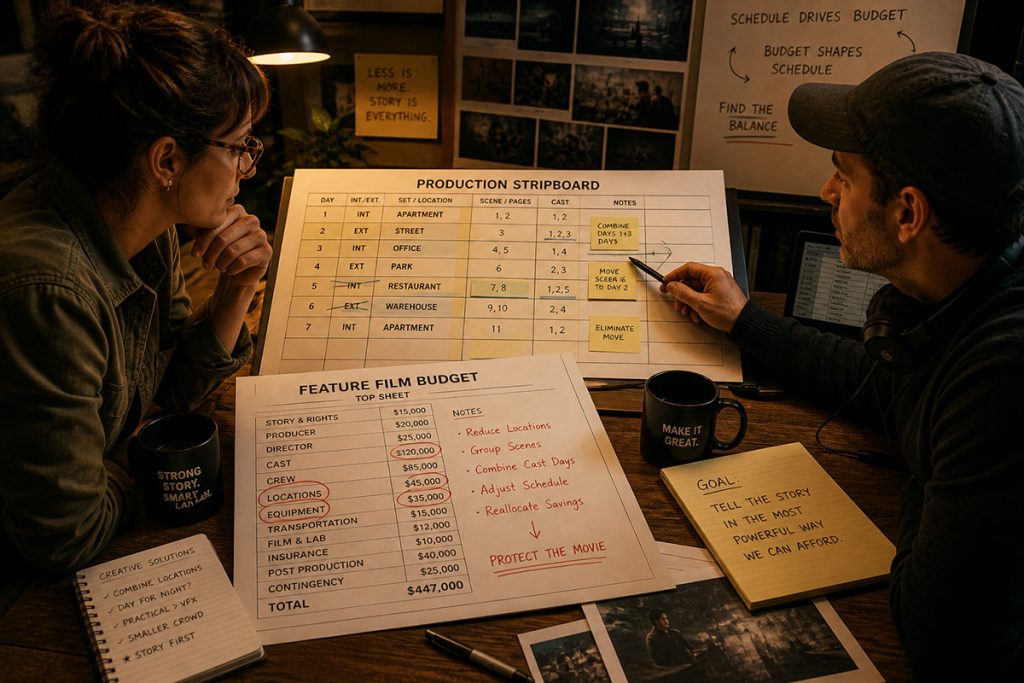
The schedule affects the budget, but the budget also pushes back.
Once you know how much money the production actually has, the schedule becomes less of a wish list and more of a strategy document. The budget tells you what kind of shoot you can realistically support. It defines how many days you can afford, how many locations you can manage, how large your crew can be, and how much complexity the production can carry before it starts to wobble.
This is where many productions have to make their first serious creative decisions.
A script may include fifteen locations, night exteriors, crowd scenes, picture cars, stunts, and multiple company moves. On the page, those scenes may feel essential. But once the budget is built, the production team may discover that the current schedule cannot support all of them as written.
That does not automatically mean the movie gets worse.
In fact, budget pressure can often make a film sharper.
A limited budget forces filmmakers to ask better questions. Can two locations be combined into one? Can a scene written for a restaurant take place in a character’s apartment instead? Can a night exterior become a day scene? Can three small scenes be grouped into a single production day? Can a supporting character’s scenes be clustered to reduce actor hold days?
These are not just compromises. They are production decisions.
A strong producer or assistant director does not simply say, “We can’t afford this.” They look for the version of the idea that still works creatively while fitting the production reality.
That is the real craft of pre-production.
The goal is not to strip away everything ambitious. The goal is to identify which elements matter most and protect them. Maybe the action sequence is essential, but the number of locations can be reduced. Maybe the large cast scene needs to stay, but it can be scheduled earlier in the day to avoid overtime risk. Maybe a specialty piece of equipment is worth renting, but only if all scenes requiring it are grouped together.
This is why budgeting and scheduling should happen together, not separately.
If the budget is created in isolation, it may look accurate on paper but fail once the schedule reveals the real demands of production. If the schedule is created without budget awareness, it may look efficient but quietly exceed what the production can afford.
The best version is a loop.
The budget informs the schedule.
The schedule reveals budget problems.
The budget is adjusted.
The schedule is refined.
Each pass gets the production closer to something realistic, shootable, and creatively focused.
For independent filmmakers, this process is especially valuable. When resources are limited, clarity becomes power. You may not be able to afford every idea in the script, but you can decide where the money matters most.
A smart budget does not just limit your schedule.
It helps shape the version of the film you can actually make.
Bringing Scheduling and Budgeting Together
By this point, the pattern is clear.
The schedule shapes the budget.
The budget reshapes the schedule.
Neither one works well in isolation.
When these two elements drift apart, productions start reacting instead of planning. Costs appear late. Adjustments feel rushed. Decisions become compromises instead of strategies.
Bringing scheduling and budgeting together changes that dynamic.
Instead of treating them as separate documents, they become part of the same system. A change in one immediately informs the other. Moving a scene is no longer just a creative or logistical choice—it becomes a financial one that can be evaluated in context.
This is where many productions gain a real advantage.
When a schedule and budget live in the same workflow, filmmakers can test decisions before they become problems. They can explore different approaches, compare outcomes, and choose the path that protects both time and resources.
For example, grouping scenes by location might reduce company moves. That decision can shorten the schedule, which in turn lowers crew costs and equipment rentals. On the other hand, spreading those scenes out may increase flexibility but extend the overall timeline. When both scheduling and budgeting are connected, those trade-offs become visible early.
This visibility creates confidence.
Producers can make decisions knowing the impact. Assistant Directors can build schedules that reflect real constraints. Directors can focus on creative execution instead of constant adjustments.
The process becomes proactive rather than reactive.
How Tools Like Gorilla Support This Workflow
This is exactly where professional tools begin to make a meaningful difference.
Managing a schedule in one place and a budget in another creates friction. Information has to be transferred manually. Changes take time to reconcile. Small inconsistencies can slip through unnoticed.
When both systems live together, that friction disappears.
Tools like Gorilla Scheduling and Budgeting are designed to reflect how productions actually operate. Instead of forcing filmmakers to jump between disconnected workflows, they bring scheduling and budgeting into a unified environment.
A change to the stripboard can inform the budget.
A budget constraint can guide scheduling decisions.
That connection reduces guesswork.
It also helps prevent the kind of small oversights that quietly expand costs. A missed rental extension. An unnecessary company move. An inefficient grouping of scenes. These issues rarely come from lack of effort—they come from lack of visibility.
With the right workflow, those blind spots shrink.
More importantly, the production gains flexibility. Adjustments can happen earlier, when they are easier and less expensive to make. Teams can iterate on the plan before stepping onto set, rather than solving problems in real time.
That shift alone can protect both the schedule and the budget.
Conclusion
A shooting schedule does more than organize your production.
It defines how your resources are used.
A budget does more than limit what you can do.
It shapes how your production should be built.
When those two elements work together, filmmaking becomes more controlled, more efficient, and more intentional. Problems get solved earlier. Decisions become clearer. The production gains stability.
And that stability creates space for creativity.
Because when the schedule makes sense and the budget holds, the entire team can focus on what matters most—telling the story.
Continue Learning Film Production Planning
If you’re diving deeper into production planning, understanding how stripboards connect to scheduling and budgeting is essential.
You may also find these guides helpful:
- How to Schedule a Film Shoot
- Film Budget Template (Free Guide)
- What is a Stripboard and How to Create one
Together, these form the foundation of an efficient, well-organized production.
Questions or Comments?
Have a question about stripboards or film scheduling? Feel free to leave a comment below — or reach out if you want to learn more about how professional tools can streamline your workflow.