
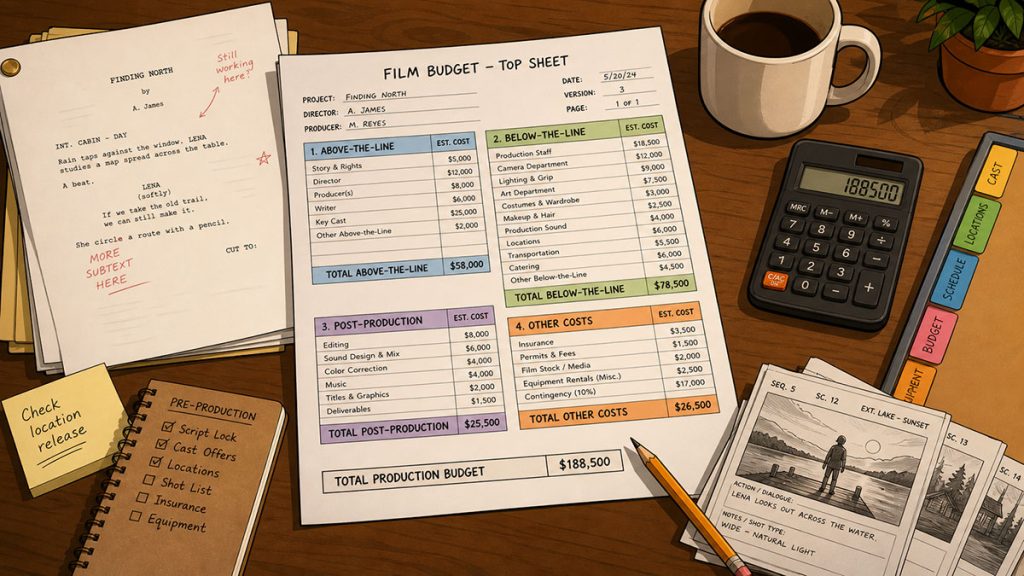
A film budget can look intimidating at first glance.
Rows of account numbers. Department names. Labor estimates. Equipment rentals. Location fees. Insurance. Post-production. Contingency. Tiny numbers that quietly become large numbers. Large numbers that somehow become even larger numbers after the production meeting.
But a film budget is not just a spreadsheet full of costs. It is a map of how the movie will be made.
Every professional film budget is divided into categories because productions are too complex to manage as one giant pile of expenses. A producer needs to know where the money is going, which costs are creative, which costs are logistical, which costs happen during the shoot, which costs happen after the shoot, and which costs are there to protect the production when reality starts throwing folding chairs.
That is where film budget categories come in.
Understanding these categories helps filmmakers, producers, directors, screenwriters, and investors see the production more clearly. It also helps the team make smarter decisions before the shoot begins.
A screenplay tells you the story.
A script breakdown tells you what the story requires.
A shooting schedule tells you when those requirements happen.
A film budget tells you what those requirements cost.
And the budget categories tell you where those costs belong.
What Are Film Budget Categories?
Film budget categories are the major sections used to organize the costs of making a movie.
Instead of listing every expense randomly, a film budget groups related costs together. This makes the budget easier to read, review, revise, and compare. It also helps producers identify where the money is being spent and where adjustments may be possible.
Most professional film budgets are divided into broad categories such as:
- Above-the-line
- Below-the-line
- Production costs
- Post-production
- Insurance
- Legal
- Publicity
- Contingency
- Financing costs
- Completion or delivery costs
Different budgeting systems and production companies may organize these categories slightly differently, but the basic logic is usually the same.
The budget separates the creative package, the physical production, the finishing process, and the costs needed to protect and deliver the film.
For independent filmmakers, understanding these categories can be the difference between a budget that looks good on paper and a budget that actually survives production.
Why Film Budget Categories Matter
Film budget categories matter because they make production decisions visible.
Without categories, a producer may only know the total cost of the movie. That is not enough.
A $500,000 film budget can mean many different things. Maybe most of the money is going to cast. Maybe the locations are unusually expensive. Maybe the crew is underfunded. Maybe post-production has been starved. Maybe the contingency is too low. Maybe the budget is pretending the movie will somehow edit, color, mix, insure, deliver, and feed itself through sheer optimism.
That is dangerous filmmaking math.
Categories help answer better questions:
Where is the money concentrated?
Is the crew budget realistic?
Are locations eating too much of the production?
Is post-production properly funded?
Has the budget included insurance and legal costs?
Is there enough contingency?
Does the budget match the actual script and schedule?
Is the production trying to look cheaper than it really is?
A film budget is not only about calculating cost. It is about revealing risk.
The Main Film Budget Categories
Most film budgets can be understood through four major areas:
- Above-the-line
- Below-the-line production
- Post-production
- Other costs
Each category plays a different role.
Above-the-line costs are usually tied to the major creative package: story rights, producers, director, writer, and principal cast.
Below-the-line costs are tied to the physical production: crew, equipment, locations, art department, wardrobe, transportation, production office, and the actual shoot.
Post-production covers everything that happens after principal photography, including editing, sound, music, color, visual effects, and deliverables.
Other costs include insurance, legal, contingency, publicity, financing, festival costs, and delivery-related expenses.
Let’s walk through each one.
👉 Looking for a Film Budget Template?
Above-the-Line Costs
Above-the-line costs are usually the major creative and rights-related expenses that are attached to the project before physical production begins.
This section often includes:
- Story rights
- Screenwriter fees
- Producer fees
- Director fees
- Principal cast
- Casting director
- Development costs
- Script revisions
- Rights clearances
- Executive producer fees, depending on the structure
The phrase “above-the-line” comes from traditional budgeting formats where these costs appeared above a dividing line separating major creative costs from the physical production costs below.
In practical terms, above-the-line is where the creative package of the movie lives.
This category may be small on a micro-budget film or enormous on a studio feature. A tiny independent film may have modest writer, producer, director, and cast fees. A major feature may have millions of dollars allocated before anyone rents a camera, books a location, or orders lunch.
For independent filmmakers, above-the-line costs require careful thinking because they can shape the entire budget.
If too much money is spent above the line, there may not be enough left to actually make the film well. If too little is allocated, the project may fail to attract the people it needs.
The goal is balance.
Story Rights and Writing Costs
Story and rights costs may include buying or optioning underlying material, paying a screenwriter, hiring a script consultant, or covering legal costs tied to chain of title.
If the film is based on a book, article, life rights, play, short story, podcast, or existing intellectual property, the rights situation should be addressed early. Ignoring rights issues can create serious legal problems later, especially when seeking distribution.
On a small original screenplay, this section may be simple.
On a film based on existing material, it can become one of the most important parts of the budget.
Producer, Director, and Cast
Producer, director, and cast fees can vary widely depending on the size of the project.
For a low-budget film, some fees may be deferred, reduced, or structured creatively. For a larger project, these fees may be negotiated with agents, managers, unions, financiers, and bond companies.
The key is to budget these costs honestly.
If the director is being paid, include it.
If producers have fees, include them.
If actors are receiving weekly rates, day rates, travel, housing, per diem, or hold days, include those costs.
A budget should not hide reality under the couch cushions.

Below-the-Line Costs
Below-the-line costs are the expenses required to physically produce the film.
This is where much of the practical production machinery lives.
Below-the-line usually includes:
- Production staff
- Assistant directors
- Production office
- Locations
- Camera department
- Grip and electric
- Sound
- Art department
- Set construction
- Props
- Wardrobe
- Hair and makeup
- Special effects
- Stunts
- Vehicles
- Transportation
- Catering and craft service
- Extras and background actors
- Production assistants
- Equipment rentals
- Production supplies
- Travel and lodging
- Security
- Permits
- Police or fire safety
- Payroll taxes and fringes
If above-the-line is the creative package, below-the-line is the physical engine.
This is where the film becomes a real production with trucks, crew, paperwork, lights, locations, meals, call times, walkie-talkies, weather problems, and someone asking whether there is enough parking for base camp.
Below-the-line costs are heavily influenced by the script breakdown and shooting schedule.
A movie with many locations, night exteriors, stunts, period wardrobe, practical effects, company moves, background actors, and special equipment will usually have higher below-the-line costs than a contained dialogue-driven film.
That does not mean one movie is better than the other. It means the budget has to reflect the production reality of the story.
Production Staff and Assistant Directors
The production staff keeps the shoot moving.
This category may include:
- Unit production manager
- Production coordinator
- Production secretary
- Production assistants
- Assistant directors
- Script supervisor
- Production accountant
- Payroll support
- Office supplies
- Communication expenses
The assistant director team is especially important because scheduling, set coordination, call sheets, company moves, and daily production flow often depend on them.
A weak production staff budget can create chaos. The production may technically save money on paper, but then lose time, organization, and sanity on set.
Good production management is not decoration. It is structural support.
Camera, Grip, Electric, and Sound
These departments are central to capturing the film.
The budget may include:
- Director of photography
- Camera operators
- 1st AC and 2nd AC
- Digital imaging technician
- Camera package
- Lenses
- Media
- Monitors
- Grip crew
- Electric crew
- Lighting package
- Generator
- Sound mixer
- Boom operator
- Sound equipment
- Walkies and communications
These costs are often schedule-driven.
If the production shoots more days, crew labor increases. If the film requires special equipment, the rental package changes. If the movie has many night exteriors, the lighting and power needs may grow. If the camera package is held for prep or wrap, those costs should be budgeted.
A camera package is not just a camera. It is the ecosystem needed to capture the film reliably.
Locations
Locations can be one of the most unpredictable budget categories.
Location costs may include:
- Location fees
- Permits
- Location manager
- Scouts
- Tech scouts
- Site reps
- Security
- Police
- Fire safety
- Parking
- Bathrooms
- Tents
- Holding areas
- Cleaning
- Restoration
- Location insurance requirements
- Neighbor agreements
- Location supplies
A location that seems inexpensive may become expensive once the production realizes there is no parking, no power, no bathrooms, no holding area, and a neighbor with the hearing of a hunting owl.
The shooting schedule has a major effect on location costs. Grouping scenes by location can reduce company moves and minimize repeated fees. Scattering scenes across multiple days can increase costs even if the location itself is affordable.
This is why location budgeting should always be tied to the schedule.
Locations can make or break your budget! Learn more about How to Create a Filmable Screenplay (That Actually Gets Produced)
Art Department, Props, Wardrobe, Hair, and Makeup
These departments create the visual world of the film.
They may include:
- Production designer
- Art director
- Set decorator
- Set dressers
- Props master
- Buyers
- Construction crew
- Scenic artists
- Wardrobe designer
- Wardrobe supervisor
- Costumes
- Fittings
- Wardrobe rentals
- Hair department
- Makeup department
- Special makeup effects
- Continuity supplies
- Multiples
These costs are often underestimated because individual items may seem small.
A jacket seems cheap until you need six versions of it.
A dinner scene seems simple until you need food styling and resets.
A bedroom seems easy until it has to reveal a character’s entire life.
A blood effect seems like one makeup cost until wardrobe needs multiples, props need duplicates, and the schedule needs reset time.
The script breakdown is essential here. Every prop, costume, set dressing item, special makeup requirement, and continuity issue should feed the budget.
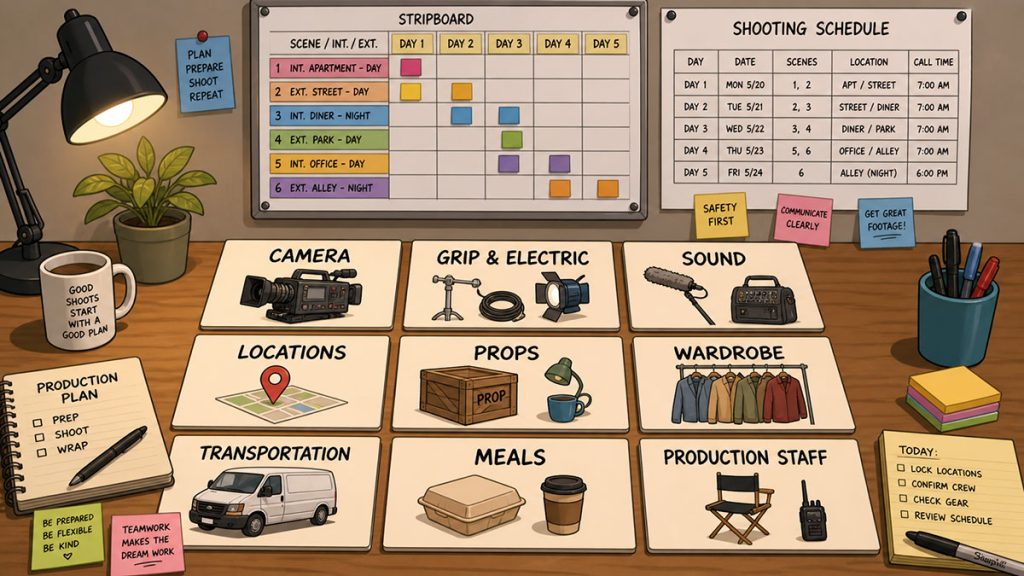
Transportation, Meals, and Production Logistics
These categories are not glamorous, but they can quietly dominate a budget.
Transportation may include:
- Passenger vans
- Cargo vans
- Trucks
- Drivers
- Fuel
- Mileage
- Parking
- Vehicle rentals
- Picture vehicle transportation
- Travel days
- Lodging
Meals may include:
- Catering
- Craft service
- Water
- Coffee
- Snacks
- Dietary needs
- Meal penalties, depending on the production
- Additional meals for large cast or background days
Logistics are where the movie’s physical footprint becomes expensive.
The more people, equipment, locations, and company moves a production has, the more these categories matter.
This is also where a realistic shooting schedule can protect the budget. Fewer company moves and better location grouping can reduce transportation, fuel, parking, and meal complications.
Post-Production Costs
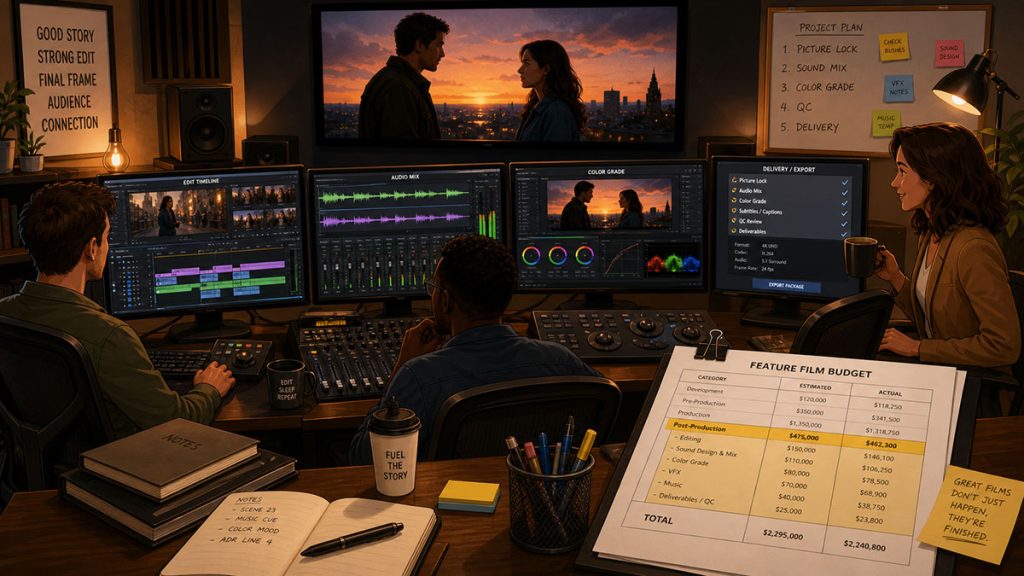
Post-production costs are the expenses required to finish the film after shooting.
This category often includes:
- Editor
- Assistant editor
- Editing system
- Hard drives and storage
- Sound editing
- Dialogue editing
- ADR
- Foley
- Sound design
- Re-recording mix
- Composer
- Music licensing
- Color correction
- Visual effects
- Titles
- Deliverables
- Mastering
- Subtitles or captions
- QC
- Trailer editing
- Post supervisor
Post-production is where many low-budget films get into trouble.
During production, it is tempting to spend everything on the shoot and assume post will somehow work itself out later. That is a dangerous assumption. A movie is not finished when principal photography wraps. It is finished when the picture is edited, sound is mixed, color is completed, music is handled, deliverables are created, and the final master is ready.
Post-production should be budgeted from the beginning, not treated as a mysterious cave at the end of the map.
Editing and Picture Post
Editing costs may include the editor, assistant editor, editing equipment, storage drives, software, syncing, organizing footage, and multiple cuts.
Even small films generate a large amount of media. That media has to be backed up, organized, labeled, and managed. If the workflow is messy, post-production becomes slower and more expensive.
A clean post workflow begins during production.
That means proper media handling, camera reports, sound reports, script supervisor notes, and organized handoffs from set to post.
Sound, Music, and Mix
Sound is one of the most important finishing categories.
It may include dialogue editing, background sound, sound design, Foley, ADR, music composition, music licensing, and the final mix.
Poor sound can make a good film feel amateur. Strong sound can make a modest film feel much more polished.
Music also deserves early attention. If the script includes source music, a dance sequence, a band, a radio, a nightclub, or recognizable songs, music licensing may become a budget issue. Original score may also require composer fees, musicians, studio time, and mixing.
The soundtrack is not a decorative ribbon tied on at the end. It is part of the film’s final architecture.
Color, Visual Effects, and Deliverables
Color correction and finishing help unify the look of the film.
Visual effects may include screen replacements, cleanup, compositing, titles, set extensions, sky replacements, muzzle flashes, blood cleanup, monitor graphics, or more complex work.
Even films that are not “VFX movies” often need some visual effects.
Deliverables may include final masters, audio stems, captions, subtitles, export versions, trailer files, festival files, distributor-required formats, and quality control.
If the film is intended for distribution, deliverables should not be ignored. A film that cannot be properly delivered may face expensive surprises later.
Other Film Budget Costs
Other costs are the expenses that do not always fit neatly into above-the-line, below-the-line, or post-production.
These may include:
- Insurance
- Legal
- Accounting
- Payroll services
- Completion bond
- Financing fees
- Interest
- Publicity
- Festival submissions
- Marketing materials
- Delivery expenses
- Contingency
- Taxes
- Union fringes
- Permits
- Workers’ compensation
- Errors and omissions insurance
Some of these costs may appear in different sections depending on the budget format. The important thing is that they are included somewhere.
A budget that excludes these costs may look more affordable than it really is.
That kind of budget is a paper lantern in a rainstorm.
Insurance
Insurance protects the production against risk.
Depending on the project, insurance may include:
- General liability
- Workers’ compensation
- Equipment insurance
- Auto insurance
- Cast insurance
- Errors and omissions insurance
- Special coverage for stunts, animals, vehicles, or hazardous activity
Insurance requirements may be driven by locations, rental houses, unions, investors, distributors, or legal obligations.
Skipping insurance is not a clever savings strategy. It is often a sign that the production is underbudgeted.
Legal and Accounting
Legal and accounting costs may include:
- Production attorney fees
- Chain of title review
- Contract review
- Actor agreements
- Crew agreements
- Vendor agreements
- Location agreements
- Music licenses
- Payroll setup
- Tax filings
- Production accounting
- Investor documents
These costs matter because films are legal and financial entities, not just creative projects.
A film with unclear rights, missing agreements, or sloppy accounting may have trouble securing distribution or satisfying investors.
Contingency
Contingency is money set aside for unexpected costs.
It is one of the most important categories in the budget.
Unexpected costs are not rare in production. They are the house band.
Weather changes. Locations fall through. Gear breaks. Scenes run long. A company move takes longer than expected. A prop does not arrive. An actor gets sick. A parking plan collapses. A night shoot needs extra safety support. Post-production needs more time.
Contingency gives the production room to respond without immediately damaging the movie.
Many budgets include contingency as a percentage of the total, often around 5% to 10%, though the appropriate amount depends on the size and risk level of the production.
A film with stunts, animals, children, water work, night exteriors, remote locations, or many company moves may need a stronger contingency than a contained interior drama.
Fringes, Payroll, and Taxes
Fringes are additional labor-related costs beyond base wages.
They may include payroll taxes, workers’ compensation, pension and health contributions, union fringes, payroll service fees, and other required labor costs.
This is an area where inexperienced filmmakers often underestimate the budget. A crew member’s rate is not always the full cost of hiring that crew member.
If someone is paid $500 per day, the production may owe additional costs on top of that depending on employment structure, location, union status, payroll setup, and legal requirements.
Fringes can have a major effect on the final budget and should be handled carefully.
How the Script Breakdown Affects Film Budget Categories
Film budget categories should not be filled in randomly.
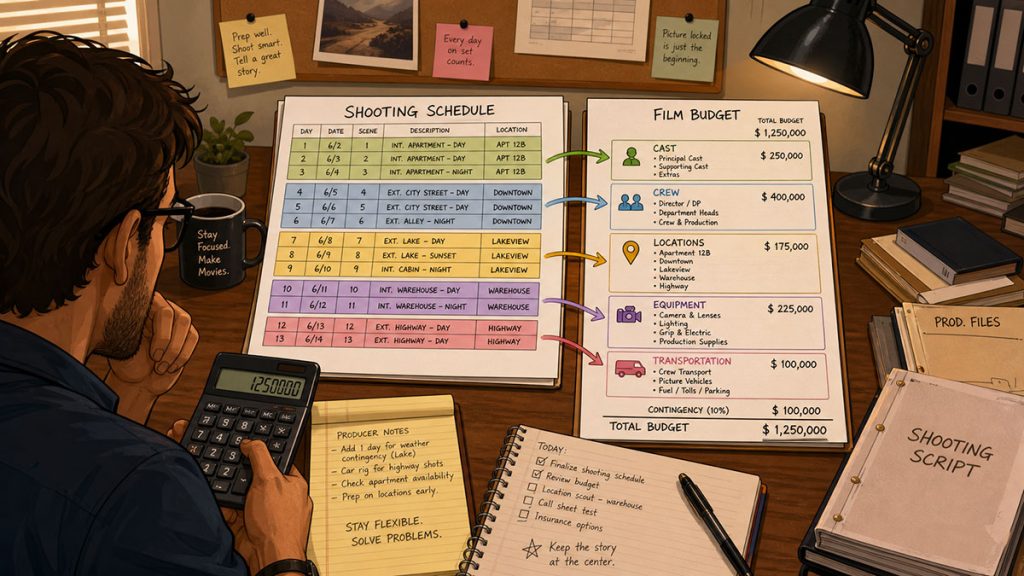
They should come from the script breakdown and shooting schedule.
For example:
A scene with two actors in a living room affects cast, crew, location, art department, wardrobe, props, camera, lighting, sound, meals, and schedule days.
A scene with a car chase affects vehicles, stunts, safety, locations, permits, police, transportation, camera, grip, lighting, insurance, and contingency.
A scene with a fantasy creature affects makeup effects, visual effects, wardrobe, art department, post-production, and possibly additional shoot time.
The breakdown reveals the elements.
The schedule reveals how often and how long those elements are needed.
The budget categories organize the costs.
This is why budgeting before breaking down the script can lead to fantasy numbers.
A producer may think the film is affordable until the breakdown reveals 37 locations, 11 night exteriors, 3 crowd scenes, 2 children, 1 dog, 4 picture vehicles, and a climactic rainstorm.
At that point, the budget stops whispering and starts speaking in capital letters.
How the Shooting Schedule Affects Film Budget Categories
The same script can produce different budgets depending on how it is scheduled.
If actor scenes are spread out across many weeks, cast costs may increase. If locations are shot inefficiently, location costs and transportation costs may rise. If night scenes are scattered throughout the shoot, crew fatigue and lighting costs may increase. If equipment is needed for only two days but rented for two weeks, the equipment budget may swell.
The shooting schedule affects categories such as:
- Cast
- Crew
- Equipment
- Locations
- Transportation
- Catering
- Production office
- Travel
- Lodging
- Insurance
- Contingency
This is why scheduling and budgeting should not be treated as separate tasks.
👉 How a Shooting Schedule Impacts Your Film Budget (And Vice Versa)
A producer should review the budget after the schedule is built. If the budget is too high, the answer may not be to slash rates. The smarter answer may be to improve the schedule.
Group locations.
Cluster actor days.
Reduce company moves.
Separate complex days from heavy dialogue days.
Avoid spreading specialty equipment across too many days.
Control night work.
Schedule expensive elements efficiently.
A smart schedule can protect multiple budget categories at once.
Common Film Budget Category Mistakes
Mistake 1: Underfunding Post-Production
Many filmmakers spend heavily on the shoot and leave too little for editing, sound, color, music, and deliverables.
This creates a painful problem: the movie gets shot but cannot be finished properly.
Post-production should be budgeted from the start.
Mistake 2: Forgetting Fringes and Payroll Costs
Base wages are only part of labor costs. Taxes, fringes, payroll fees, workers’ compensation, and union-related costs can significantly affect the final budget.
Ignoring them makes the budget look cleaner but less accurate.
Mistake 3: Treating Locations as Simple Fees
A location fee is only one part of the location cost.
Permits, parking, bathrooms, site reps, power, security, police, restoration, and company moves can all affect the budget.
A “free” location may not be free once the full production footprint is considered.
Mistake 4: Using One Big Miscellaneous Category
A miscellaneous category can be useful, but it should not become a swamp where unclear costs disappear.
If too many expenses are hidden under miscellaneous, the budget becomes harder to manage.
Mistake 5: Cutting Contingency Too Early
Contingency is often one of the first things filmmakers cut when they want the budget to look smaller.
That may help the document look better in a meeting, but it does not help the production when something goes wrong.
Contingency is not extra money. It is protection.
Mistake 6: Separating the Budget from the Schedule
If the budget is not connected to the schedule, the production may miss major cost drivers.
Actor days, location days, equipment rentals, crew weeks, travel, and lodging are all schedule-sensitive.
A budget that ignores the schedule is incomplete.
How Gorilla Budgeting Helps Organize Film Budget Categories
Film budgeting becomes much easier when costs are organized in a professional structure.
Gorilla Budgeting is designed to help filmmakers build detailed film budgets with organized accounts, categories, globals, fringes, groups, sub-groups, tax credits, deferments, ratebook tools, and expense tracking.
That structure matters because a film budget is rarely static.
As the script changes, the budget changes.
As the schedule changes, the budget changes.
As cast, crew, location, equipment, and post-production assumptions change, the budget changes again.
Professional budgeting software helps keep those changes organized so the producer is not chasing numbers through scattered spreadsheets and handwritten notes like a raccoon in a filing cabinet.
For filmmakers moving from a script breakdown to a real production plan, Gorilla Budgeting can help create a clearer path from creative ambition to financial reality.
The goal is not just to make a budget.
The goal is to make a budget that can be revised, reviewed, defended, and actually used.
Film Budget Categories Checklist
Before finalizing a film budget, review each major category:
Above-the-Line
- Story rights
- Writer
- Producer
- Director
- Principal cast
- Casting
- Development costs
- Rights and clearances
Below-the-Line
- Production staff
- Assistant directors
- Camera
- Grip and electric
- Sound
- Locations
- Art department
- Props
- Wardrobe
- Hair and makeup
- Transportation
- Catering and craft service
- Background actors
- Equipment rentals
- Production office
- Travel and lodging
Post-Production
- Editing
- Assistant editing
- Storage
- Sound editing
- ADR
- Foley
- Sound mix
- Music
- Color correction
- Visual effects
- Titles
- Deliverables
- Captions and subtitles
- QC
Other Costs
- Insurance
- Legal
- Accounting
- Payroll
- Fringes
- Completion bond
- Financing costs
- Publicity
- Festival costs
- Contingency
- Taxes
- Delivery expenses
This checklist is not a replacement for a full professional budget, but it can help make sure the major cost areas are not forgotten.
Final Thoughts
Film budget categories are more than accounting labels.
They are the production’s way of telling you how the movie is built.
Above-the-line shows the creative package.
Below-the-line shows the physical shoot.
Post-production shows how the film will be finished.
Other costs show how the production is protected, delivered, and kept alive when the unexpected arrives wearing a fake mustache.
For screenwriters, understanding film budget categories can make the writing more production-aware.
For directors, it can clarify which creative choices carry major cost implications.
For producers, it turns the budget into a management tool instead of a stack of numbers.
A good budget does not kill creativity. It gives creativity a structure strong enough to survive production.
When the categories are clear, the team can see the movie more clearly.
And when the team sees the movie more clearly, they can make better decisions long before the first call sheet goes out.
Continue Learning Film Production Planning
If you’re diving deeper into production planning, understanding how stripboards connect to scheduling and budgeting is essential.
You may also find these guides helpful:
- How to Schedule a Film Shoot
- Film Budget Template (Free Guide)
- What is a Stripboard and How to Create one
- How to Write a Filmable Screenplay
- What Is a Call Sheet in Film? (Free Download)
- What Is a Crew Deal Memo (And Why It Can Save Your Production)
- How a Shooting Schedule Impacts Your Film Budget
- What Is a Production Strip in Film Scheduling?
- How to Turn a Script Breakdown Into a Film Budget
Together, these form the foundation of an efficient, well-organized production.
Questions or Comments?
Have a question about stripboards or film scheduling? Feel free to leave a comment below — or reach out if you want to learn more about how professional tools can streamline your workflow.