
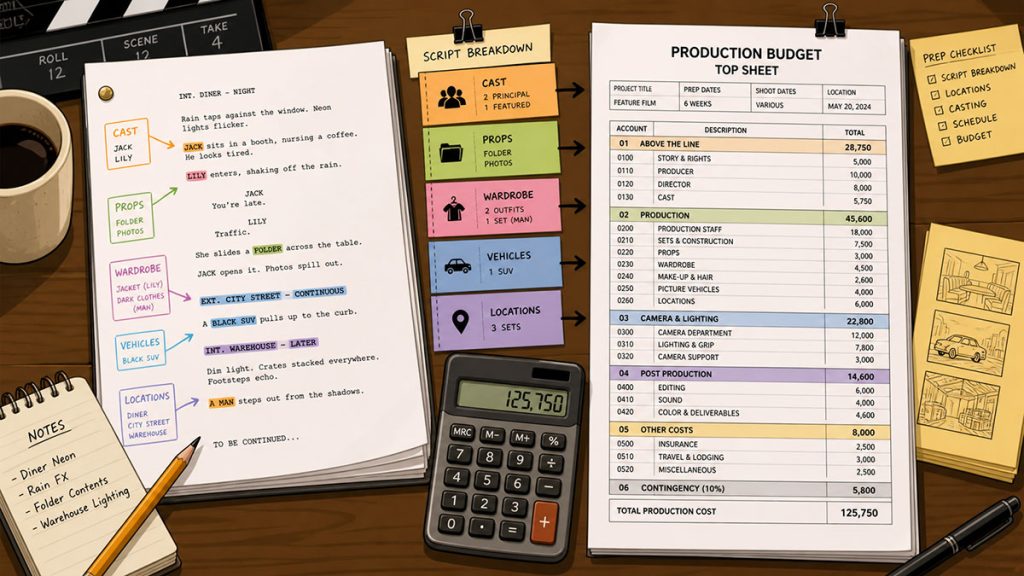
A screenplay may begin as imagination, but a film budget is where imagination gets a price tag.
That line on page 12 that says, “A crowd fills the street as rain pours down around the burning car,” might read beautifully in a script. On a budget, it becomes background actors, picture vehicles, rain towers, fire safety, permits, police control, night premiums, overtime risk, wardrobe resets, stunt coordination, special effects, extra insurance, and a location manager quietly wondering if the production has lost its mind.
That is why a script breakdown matters.
A script breakdown is not just a list of props, costumes, and characters. It is the first serious translation of the screenplay into production reality. Once every scene has been broken down, the producer, line producer, production manager, and assistant director can begin asking the questions that actually shape the budget:
How many days will this movie take to shoot?
How many actors are needed each day?
Which locations are expensive, complicated, or repeated?
Which scenes require special equipment, stunts, animals, vehicles, visual effects, or large numbers of extras? Where will the schedule create savings, and where will it create cost pressure?
A good film budget does not appear out of thin air. It grows out of the breakdown, then sharpens through the shooting schedule.
In this guide, we will walk through how to turn a script breakdown into a working film budget, one practical step at a time.
What Is a Script Breakdown Budget?
A script breakdown budget is a film budget built from the actual production requirements identified in a script breakdown.
Instead of guessing costs from the title, genre, or page count alone, the production team uses the breakdown to identify what each scene requires. Those requirements are then translated into budget categories such as cast, extras, locations, art department, wardrobe, props, vehicles, animals, stunts, special effects, camera, grip and electric, production staff, transportation, post-production, insurance, and contingency.
This is the difference between saying:
“This is a 90-page indie drama, so maybe we can make it for $500,000.”
And saying:
“This is a 90-page indie drama with 12 speaking roles, 42 locations, 18 night exteriors, 3 company moves per week, 2 crowd scenes, a child actor, 4 picture vehicles, a dog, and multiple rain scenes. That changes the budget.”
The second version may not be as romantic, but it is much more useful.
A script breakdown budget does not remove creativity from filmmaking. It protects creativity by making the hidden costs visible before production begins.
Why the Script Breakdown Comes Before the Budget
Many first-time filmmakers start with a number.
They say, “We have $100,000. What can we shoot?”
That is a valid starting point, especially in independent filmmaking. But even then, the script has to be tested against the budget. A $100,000 contained thriller set in one house is very different from a $100,000 road movie with 28 locations, night driving, police cars, and a child actor.
The script breakdown gives the producer a way to examine the screenplay before money is committed in the wrong places.
A breakdown identifies the production elements in each scene, including:
- Cast
- Background actors
- Props
- Wardrobe
- Makeup and hair
- Set dressing
- Vehicles
- Animals
- Stunts
- Special effects
- Visual effects
- Music playback
- Special equipment
- Locations
- Practical effects
- Production notes
Once those elements are identified, the budget becomes less theoretical. The producer can begin pricing the movie based on what the script actually demands.
In professional film production, this is where scheduling and budgeting begin to dance with each other. The breakdown reveals what is needed. The shooting schedule reveals when and how often it is needed. The budget reveals what those choices will cost.
That three-part relationship is the heart of real pre-production.
Step 1: Break Down Every Scene Before Estimating Costs
The first mistake many filmmakers make is budgeting too early.
They skim the script, make broad assumptions, then begin typing numbers into a spreadsheet. That can work for a rough estimate, but it is not enough for a serious production budget.
Before building the budget, each scene should be broken down carefully. This means reading the screenplay scene by scene and tagging every element that affects production.
For example, a simple scene heading might say:
EXT. GAS STATION – NIGHT
That one line already affects the budget.
It tells you the production may need a real location, night shooting, exterior lighting, possibly a generator, location fees, company parking, permits, bathrooms, security, and maybe additional time for setup. If the scene includes a car pulling in, a cashier behind the counter, rain, signage, extras, or a stunt, the cost grows again.
A strong breakdown does not just identify the obvious elements. It catches the quiet ones hiding in plain sight.
👉 How to Break Down a Script for Film Production (Step-by-Step Guide)
A character “checks his phone” means a phone prop.
A detective “studies the bloody jacket” means wardrobe multiples, aging, props, and possibly special effects makeup.
A family “sits down for Thanksgiving dinner” means food styling, table dressing, wardrobe continuity, props, and maybe child actor work restrictions.
A line like “the city burns in the distance” means visual effects or a creative rewrite.
The breakdown is where the movie starts telling you what it really costs.
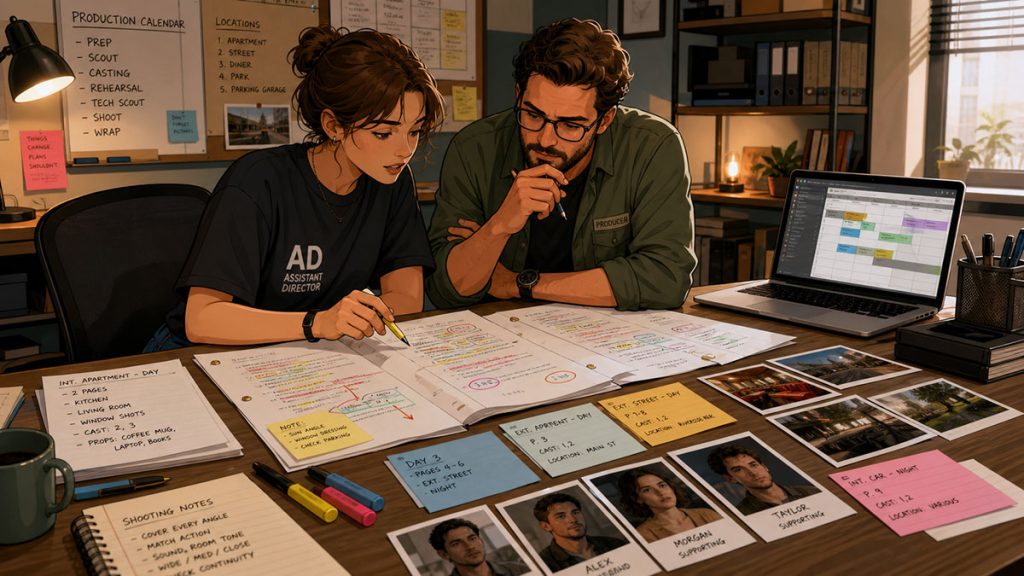
Step 2: Group Breakdown Elements by Budget Category
Once the script is broken down, the next step is to group the elements into budget categories.
This is where creative details become accounting lines.
A prop does not stay “a prop” forever. It becomes part of the props budget. A police car becomes a picture vehicle cost. A nightclub full of background actors becomes extras, wardrobe, location, production design, music clearance, playback, security, and possibly overtime.
Most film budgets organize costs into broad sections such as:
Above-the-line: producers, director, writer, principal cast, and other key creative costs.
Below-the-line production: crew, equipment, locations, art department, wardrobe, props, set operations, transportation, production office, and other shoot-related expenses.
Post-production: editing, sound, music, color, visual effects, deliverables, and finishing.
Other costs: insurance, legal, publicity, festival costs, contingency, financing expenses, and miscellaneous costs.
The breakdown mostly feeds the below-the-line production budget, but it can also affect above-the-line and post-production.
For example, if a script has many speaking roles, that affects casting and talent costs. If it has heavy visual effects, that affects post-production. If it has stunts, firearms, animals, minors, or dangerous scenes, that affects insurance, safety, legal review, and crew requirements.
Do not think of the breakdown as a separate document from the budget. Think of it as the budget’s evidence file.
Step 3: Build a Shooting Schedule Before Finalizing the Budget
A script breakdown tells you what the film needs.
The shooting schedule tells you how those needs stack up across time.
This matters because film budgets are not only based on what appears in the script. They are based on how many days those elements are needed.
An actor who appears in 20 scenes might work 5 days or 18 days depending on how the scenes are scheduled. A location that appears throughout the script might be shot in 2 efficient days or scattered across multiple weeks. A prop vehicle may be rented for one day or held for half the shoot.
That is why the shooting schedule has such a direct impact on the budget.
When the assistant director builds the stripboard, scenes are usually arranged based on factors such as:
- Location
- Cast availability
- Day or night scenes
- Interior or exterior scenes
- Company moves
- Child actor restrictions
- Stunts or special effects
- Equipment needs
- Weather exposure
- Production difficulty
- Scene continuity
- Page count per day
The producer should not finalize the budget until the schedule has been tested. Otherwise, the budget may look clean on paper but collapse during prep.
A five-week schedule and a four-week schedule can produce very different budgets, even with the same script. The shorter schedule may reduce weekly rentals and crew costs, but it may also increase overtime, fatigue, company moves, and production risk. The longer schedule may cost more in labor weeks but allow safer, more controlled days.
The cheapest schedule is not always the best schedule. The best schedule is the one that balances money, time, safety, performance, and production reality.
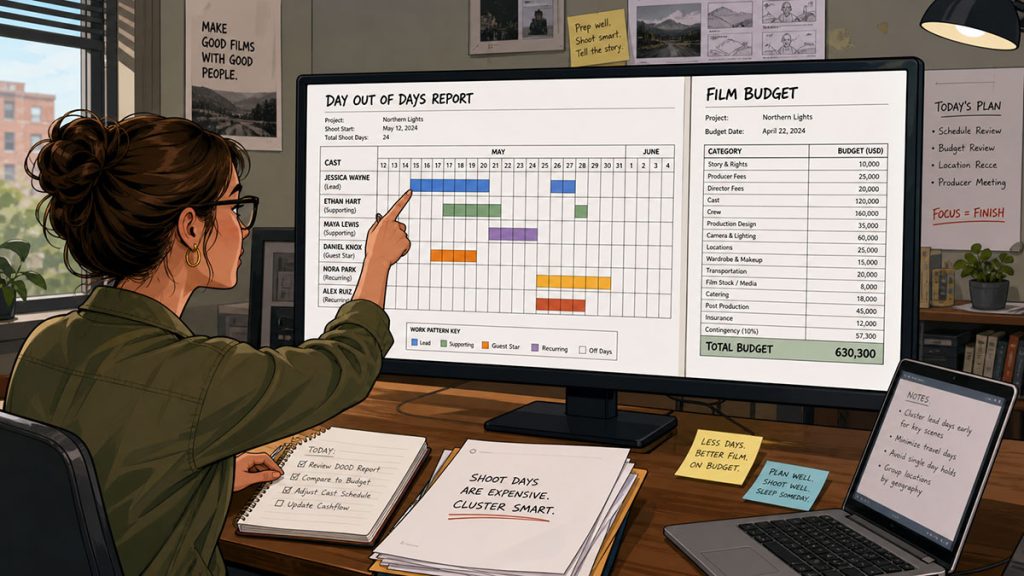
Step 4: Use the Day Out of Days to Estimate Cast Costs
Once the shooting schedule is built, the Day Out of Days report becomes one of the most useful budgeting tools.
A Day Out of Days report, often called a DOOD, shows when each actor starts work, works, holds, travels, or finishes. It helps the production team understand not just how many scenes an actor appears in, but how many days the actor may need to be paid for.
This is critical because actor costs are often driven by work patterns.
A supporting actor may only appear in five scenes, but if those scenes are spread across three weeks, the production may face additional hold days, travel days, or scheduling complications. A smart schedule can group that actor’s scenes together and reduce costs.
For example:
Actor A appears in scenes 3, 14, 27, and 52.
If those scenes are shot on four separate weeks, the actor may become expensive.
If those scenes are grouped into two shoot days, the cost may become much more manageable.
👉 What Is a Day Out of Days Report in Film Production?
This is where the assistant director and producer can save real money without cutting anything from the script.
The DOOD also helps identify cast congestion. If many actors are needed on the same day, that may increase makeup, wardrobe, holding space, transportation, meal costs, and company coordination. If background actors are also involved, the day becomes even more expensive.
The budget should reflect these work patterns, not just the number of roles.
Step 5: Identify the Expensive Scenes
Not all pages cost the same.
One page of dialogue between two characters in a kitchen may be relatively inexpensive. One eighth of a page involving a car crash, rain effect, stunt performer, police vehicles, night exterior lighting, and street closure may be one of the most expensive moments in the film.
This is why budgeting by page count alone can be dangerous.
After the breakdown and schedule are complete, review the script for high-cost scenes. These are the scenes that carry unusual production weight.
Common expensive scene types include:
- Night exteriors
- Crowd scenes
- Period scenes
- Stunts
- Fight scenes
- Car work
- Water work
- Animals
- Children
- Firearms
- Rain or weather effects
- Special effects
- Visual effects
- Company moves
- Remote locations
- Scenes requiring heavy art department builds
- Scenes with multiple principal actors
- Scenes with extras, vehicles, and picture cars
- Scenes with music playback or choreography
Each expensive scene should be examined individually.
Ask: What does this scene require?
Can it be shot safely?
Can it be simplified without damaging the story?
Can it be combined with another scene?
Can the location be reused?
Can the effect be implied instead of shown?
Can the same dramatic result be achieved with fewer production variables?
This is not about watering down the movie. It is about making sure the budget supports the creative intention.
Sometimes the answer is, “Yes, this scene is expensive, and it is worth it.”
Other times the answer is, “This scene is quietly eating the movie alive.”
Step 6: Convert Locations Into Real Budget Numbers
Locations are one of the biggest places where a script breakdown becomes a budget conversation.
A script may list 20 locations, but the budget needs to know much more than that.
Is the location free or paid?
Does it require a permit?
Is there parking?
Can trucks get close?
Is there power?
Can the crew use bathrooms?
Is there a holding area for cast?
Can sound be controlled?
Are there neighbors?
Are there time restrictions?
Can the location be dressed ahead of time?
Will the production need security?
Will the company need to move during the day?
A location is never just a location. It is a small temporary production ecosystem.
When reviewing the breakdown, look for ways to reduce location costs through scheduling and creative consolidation. A script with eight different apartments might be rewritten or designed so that three apartments can be filmed in one building. A police station, office, and hospital hallway might be found in the same practical location. A school, church, or community center might double for several story spaces.
This is where producers and writers can collaborate in a useful way. Screenwriters do not need to strip all ambition from the script, but they should understand that every new location creates time, cost, and logistical pressure.
The budget becomes stronger when the locations are not only counted, but strategically planned.
Step 7: Budget Props, Wardrobe, and Set Dressing from the Breakdown
Props, wardrobe, and set dressing are often underestimated because each individual item may seem small.
But small items multiply quickly.
A restaurant scene may require menus, plates, food, glasses, table dressing, background props, signage, wardrobe for waitstaff, wardrobe for background actors, continuity multiples, cleaning supplies, and resets between takes. None of those items may seem dramatic by themselves. Together, they create real budget weight.
The breakdown helps the art department and wardrobe team understand what must be bought, rented, built, altered, aged, duplicated, cleared, returned, or stored.
Pay special attention to:
- Hero props
- Breakaway props
- Food props
- Period props
- Weapons
- Phones, laptops, and screens
- Branded items requiring clearance
- Wardrobe changes
- Stunt wardrobe
- Blood or dirt continuity
- Multiples for action scenes
- Special makeup or hair continuity
- Background wardrobe needs
For budgeting, the question is not only “What appears on screen?” It is also “How many versions of this do we need to survive production?”
A shirt worn in a clean dialogue scene may require one piece. A shirt worn during a fight in the rain with blood effects may require multiples. A phone that gets smashed may need several duplicates. A dinner scene may require reset food for multiple takes.
The script breakdown catches the item. The budget catches the real-world cost of using it.
Step 8: Use the Schedule to Estimate Crew and Equipment
Crew and equipment costs are usually driven by time.
The breakdown tells you what kind of crew and equipment the production may need. The schedule tells you how long those resources are needed.
A simple dialogue-heavy drama may require a lean crew and modest equipment package. A film with complex camera movement, night exteriors, stunts, visual effects, or large locations may require additional departments, specialty crew, prep time, rigging time, and equipment rentals.
When reviewing the schedule, look for days that may require special crew or gear:
- Steadicam or gimbal days
- Drone work
- Crane or jib shots
- Process trailer work
- Second unit work
- Stunt coordination
- Intimacy coordination
- Special effects crew
- Visual effects supervision
- Additional grip and electric
- Generator rentals
- Condors or lifts
- Rain towers
- Green screen setups
- Playback equipment
- Additional production assistants
- Police or fire safety personnel
The budget should reflect these needs clearly. Do not bury specialty requirements inside vague line items. If a scene needs additional gear or crew, the budget should show it.
This makes the budget easier to defend and easier to adjust.
Step 9: Build in Prep, Wrap, and Contingency
A common beginner mistake is budgeting only for shoot days.
But productions do not begin when the camera rolls, and they do not end when the final shot is captured.
Crew may need prep days. Locations may need scouts and tech scouts. Art department may need time to build or dress sets. Wardrobe may need fittings. Camera and grip departments may need prep. Production may need office time, paperwork, insurance, permits, payroll setup, deal memos, and vendor coordination.
After the shoot, there may be returns, wrap days, location restoration, final invoices, storage, shipping, and accounting cleanup.
The breakdown and schedule should help identify which departments need prep and wrap time.
A contained two-location drama may need limited prep. A period film with stunts, vehicles, and many locations may need extensive prep. A budget that ignores prep days is not lean. It is incomplete.
Contingency is also essential. Even a carefully planned production will face surprises. Weather changes. Actors get sick. Locations fall through. Equipment breaks. Scenes run long. A budget without contingency is a budget pretending production will behave itself.
Production rarely behaves itself.
Step 10: Revisit the Script if the Budget Does Not Work
This is where the process becomes creative again.
If the first budget is too high, do not immediately slash crew rates or remove contingency. Go back to the script and schedule.
The best savings often come from creative production decisions:
Can two locations become one?
Can a night exterior become a day interior?
Can a crowd scene become a tighter, more intimate scene?
Can a company move be eliminated?
Can a minor character be combined with another role?
Can an expensive prop, vehicle, or effect be rewritten?
Can the schedule group actors more efficiently?
Can a scene be staged in a way that reduces equipment needs?
Can a sequence be implied through sound, editing, or production design?
This is where a filmmaker’s craft matters.
Budgeting is not just accounting. It is creative problem-solving with numbers attached.
The goal is not to make the movie smaller. The goal is to make the production smarter.
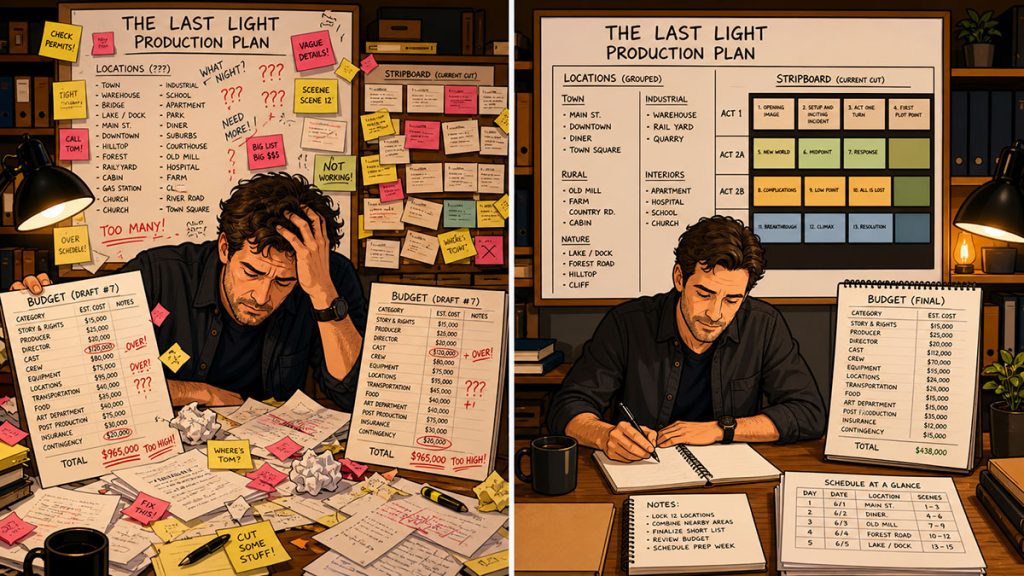
How Gorilla Scheduling and Gorilla Budgeting Fit Into the Workflow
The script breakdown, shooting schedule, and film budget should not live in separate worlds.
When those documents are disconnected, information gets lost. A scene changes, but the budget does not update. An actor’s work days shift, but the cost estimate remains old. A location gets combined, but the schedule and budget no longer match. The production team starts making decisions from different versions of reality.
That is where professional film production software becomes valuable.
Gorilla Scheduling helps filmmakers move from screenplay import to breakdown sheets, stripboards, cast, crew, locations, calendars, and scheduling reports. Gorilla Budgeting supports professional budgeting needs such as globals, fringes, sub-groups, tax credits, deferments, fourth-level budgeting, union ratebook integration, and expense tracking.
Used together, scheduling and budgeting software can help a production team keep the creative, logistical, and financial sides of the movie connected.
The software does not make the creative decisions for you. It gives you a professional structure for making those decisions with better information.
For independent filmmakers, that structure can be the difference between guessing and planning.
For producers, it creates a clearer path from script to schedule to budget.
For screenwriters, it reveals how choices on the page affect the physical production.
Practical Example: One Script Scene, Many Budget Lines
Let’s look at a fictional scene:
EXT. SUBURBAN STREET – NIGHT
A teenage girl runs down the street in the rain. Behind her, a black SUV screeches around the corner. She slips, drops her backpack, and hides behind a parked car as police lights flash in the distance.
On the page, this may be less than half a page.
In the breakdown, it may include:
- Principal actor
- Stunt double or stunt coordinator
- Rain effect
- Night exterior
- Picture SUV
- Parked cars
- Backpack prop
- Wet wardrobe multiples
- Police lights
- Street location
- Permits
- Traffic control
- Safety personnel
- Additional lighting
- Generator
- Sound challenges
- Possible overtime risk
In the schedule, this scene may require careful placement. It might need to be grouped with other night exterior scenes. It may require a pre-light. It may need extra time because rain slows down resets. It may require coordination with neighbors and city permits.
In the budget, this one small scene can affect multiple departments:
- Cast
- Stunts
- Wardrobe
- Props
- Vehicles
- Locations
- Permits
- Grip and electric
- Special effects
- Production staff
- Transportation
- Insurance
- Contingency
This is why experienced producers do not budget only by page count. They budget by production impact.
Common Mistakes When Budgeting from a Script Breakdown
Mistake 1: Treating all pages equally
One page can cost $500 or $50,000 depending on what happens in it. Page count matters, but production complexity matters more.
Mistake 2: Forgetting background actors
Crowd scenes can affect casting, wardrobe, makeup, holding, meals, paperwork, transportation, and assistant director staffing. Background is rarely “free atmosphere.”
Mistake 3: Ignoring company moves
Moving the entire company during a shoot day costs time. Time becomes overtime, lost shots, or additional shoot days.
Mistake 4: Underestimating night shoots
Night work often requires more lighting, more planning, more safety oversight, and more fatigue management. It can also create schedule restrictions.
Mistake 5: Budgeting props and wardrobe too generally
A single line item for “props” may not be enough if the script includes hero props, breakaways, weapons, food, electronics, or duplicates.
Mistake 6: Building the budget before testing the schedule
Until the schedule is built, cast days, location days, equipment rentals, and crew weeks are still assumptions.
Mistake 7: Removing contingency to make the budget look better
A budget without contingency may impress someone for five minutes. Production will expose it later.
A Simple Workflow for Turning a Breakdown Into a Budget
Here is a practical order of operations:
- Import or prepare the screenplay.
- Break down every scene.
- Tag all cast, props, wardrobe, locations, vehicles, stunts, effects, and special requirements.
- Review the breakdown for expensive or complicated scenes.
- Build the stripboard.
- Create a realistic shooting schedule.
- Generate or review the Day Out of Days report.
- Estimate cast, location, crew, equipment, and department costs based on actual schedule needs.
- Build the production budget.
- Review high-cost areas.
- Adjust the script, schedule, or production approach if needed.
- Add prep, wrap, insurance, contingency, and post-production costs.
- Reconcile the budget against the creative priorities of the film.
This workflow keeps the production from drifting into fantasy math.
The screenplay remains the creative blueprint. The breakdown identifies the parts. The schedule determines the build order. The budget tells you what the build will cost.
Final Thoughts: The Budget Is a Creative Document
A film budget may look like a spreadsheet, but it is really a creative document.
Every number reflects a choice. More shoot days may protect performance. Fewer locations may protect the schedule. Better prep may reduce chaos. A larger art department budget may make the world feel real. A carefully planned DOOD may save enough money to keep an important scene.
When you turn a script breakdown into a budget, you are not just counting costs. You are discovering the production shape of the movie.
That process can be uncomfortable because it forces the script to meet reality. But it is also where better filmmaking begins.
A strong breakdown helps you see what the story requires.
A smart schedule helps you organize those requirements.
A realistic budget helps you protect the movie before production starts.
And when all three work together, the film has a much better chance of surviving the beautiful storm of production.
Continue Learning Film Production Planning
If you’re diving deeper into production planning, understanding how stripboards connect to scheduling and budgeting is essential.
You may also find these guides helpful:
- How to Schedule a Film Shoot
- Film Budget Template (Free Guide)
- What is a Stripboard and How to Create one
- How to Write a Filmable Screenplay
- What Is a Call Sheet in Film? (Free Download)
Questions or Comments?
Have a question about stripboards or film scheduling? Feel free to leave a comment below — or reach out if you want to learn more about how professional tools can streamline your workflow.