

Film scheduling used to be tied to a desk, a machine, and a carefully guarded file. The assistant director or producer would build the schedule, export a PDF, email it to the team, revise it, export it again, and hope everyone was looking at the latest version instead of some fossilized attachment from three revisions ago.
Online film scheduling software changes that workflow.
With Gorilla Scheduling Online, productions can build and manage a shooting schedule in a browser-based workspace. That means importing a screenplay, creating breakdown sheets, building production strips, organizing a stripboard, managing shoot days, and generating reports without being limited to one desktop computer.
The schedule is still doing the same essential production job: turning a screenplay into a practical shooting plan. The difference is that the work can now happen from more places, with better access for the people who need it.
What Is Online Film Scheduling Software?
Online film scheduling software helps filmmakers build and manage a production schedule through a web browser instead of relying only on installed desktop software or disconnected spreadsheets.
A professional film schedule is not just a list of scenes. It is a production map. It organizes script scenes into shootable days, balances cast availability, groups locations, accounts for day and night work, tracks company moves, and gives producers and assistant directors a way to understand how the film will actually be made.
Gorilla Scheduling Online brings that process into the browser while keeping the core scheduling workflow familiar: import the script, break down scenes, create strips, build the stripboard, organize shoot days, and create reports.
From Screenplay to Shooting Schedule
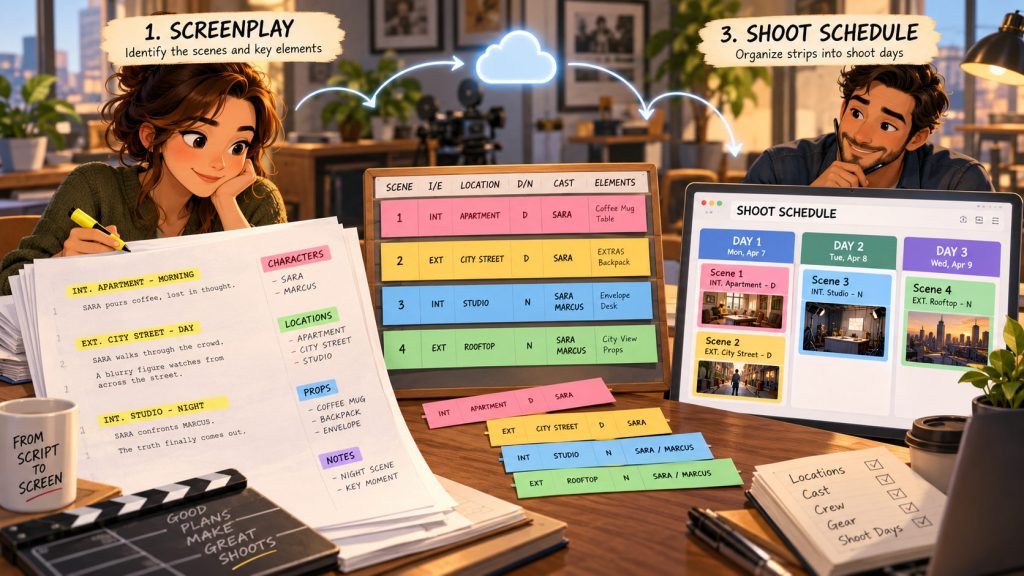
Every schedule starts with the script, but a screenplay is not yet a production plan. A scene heading may tell you the location and time of day, but it does not automatically tell you how many actors are needed, whether the location can be grouped with other scenes, whether a prop has continuity issues, or whether the production can realistically shoot those pages in one day.
That is why the first major step is the script breakdown.
With Gorilla Scheduling Online, filmmakers can import screenplay information, review scenes, identify production elements, and begin turning the written script into usable scheduling data. This is where the schedule starts to become more than a calendar. It becomes a working model of the production.
The script breakdown helps answer practical questions: Who appears in each scene? What locations are needed? What props, wardrobe, vehicles, or special elements appear? Which scenes belong together? Which scenes will be expensive or difficult to move?
Once those elements are identified, scenes can become production strips and the stripboard can begin to take shape.
Related article: Final Draft to Film Scheduling: How to Turn a Screenplay into a Shootable Schedule
Why the Stripboard Still Matters Online
The stripboard remains one of the most important tools in production scheduling. Even when the schedule lives online, the underlying logic is still the same: each scene becomes a production strip, and those strips are arranged into shoot days.
This visual structure matters because film scheduling is full of tradeoffs. Moving one strip can affect cast work days, location groupings, night work, company moves, and budget pressure. A stripboard gives the assistant director and producer a way to see the production as a set of connected decisions rather than a flat list of scenes.
Online film scheduling software does not replace that thinking. It makes the stripboard easier to access, revise, and share.
Gorilla Scheduling Online keeps the stripboard at the center of the scheduling process while giving productions the flexibility of a browser-based workflow. The schedule can still be shaped with production judgment, but the project is no longer trapped on one machine.
Anywhere Login: Why Browser Access Matters
A shooting schedule is rarely built by one person in one uninterrupted sitting. The producer may need to review the plan from home. The assistant director may revise shoot days from the production office. A production manager may need to check schedule assumptions while working on logistics. A school instructor may want to review student projects without needing access to a specific lab computer.
That is where browser access becomes useful.
With online film scheduling software, the schedule can live in a centralized online project. Team members can log in from different locations, depending on their access, and work from a more current version of the production plan.
This is especially helpful during pre-production, when changes are constant. A location falls through. An actor’s availability changes. A night shoot moves. A scene gets rewritten. The schedule needs to respond quickly, and the people making decisions need access to the updated plan.
Collaboration Without Version Chaos
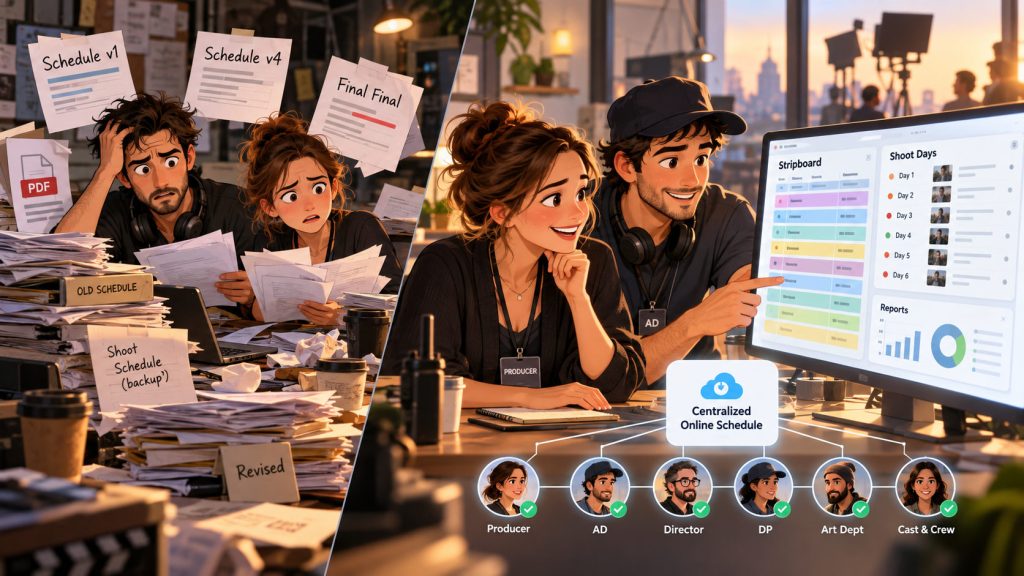
The old file-based workflow has a familiar problem: nobody is quite sure which version is current.
One person has the schedule from Monday. Another has the revised PDF from Tuesday. Someone else is working from a spreadsheet export. The producer remembers a change that never made it into the file. The assistant director is still waiting for feedback. Meanwhile, the production is making decisions from documents that no longer match.
This is not a people problem. It is a workflow problem.
Online film scheduling software helps reduce that version chaos by keeping the working project in one centralized place. Instead of treating every export as a new source of truth, the team can work from the active schedule itself.
That does not mean everyone should edit everything. Production scheduling still needs control, permissions, and clear responsibility. However, collaboration becomes much cleaner when the project is centralized instead of scattered through email attachments.
Work Offline and Sync Later
One of the most practical features of Gorilla Scheduling Online is the ability to work offline.
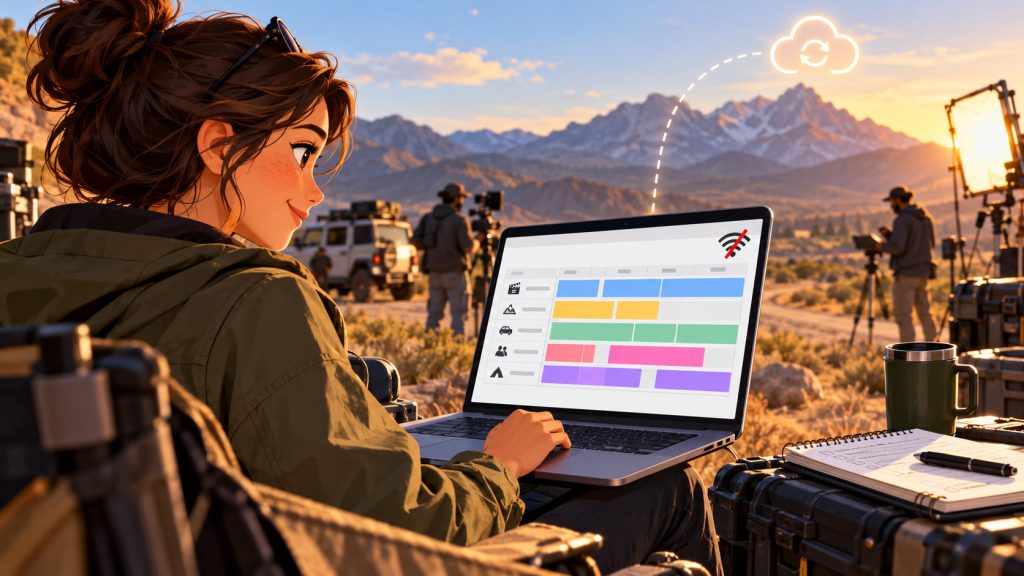
That matters because productions do not always happen in perfect internet conditions. A producer may be on a plane. An assistant director may be scouting a remote location. A film school student may be working somewhere with unreliable Wi-Fi. A production team may be on set where the signal behaves like a temperamental background actor.
With Gorilla Scheduling Online, users can continue working offline when there is no internet connection, then sync changes when they reconnect.
This gives productions a helpful balance: the flexibility of online access when connected, and the resilience of offline work when the internet disappears. For scheduling, that can be a major advantage because the work does not have to stop just because the connection drops.
Possible comparison note:
This feature can also be useful in software comparisons. Not every cloud-based production platform clearly offers full offline editing and later sync for scheduling work. For productions that travel, scout, shoot remotely, or work in unpredictable conditions, offline scheduling can be more than a convenience. It can keep the planning process moving.
Reports Make the Schedule Useful
A schedule is only useful if people can understand and act on it. That is why scheduling reports are such an important part of professional production planning.
The stripboard helps build the plan, but reports help communicate it. Producers need to understand shoot days, locations, cast usage, and schedule pressure. Assistant directors need documents that help organize the work. Production managers need a clearer picture of what the plan requires.
Gorilla Scheduling Online supports scheduling reports that help translate the stripboard into practical production information. Instead of forcing the team to manually rebuild information in separate documents, reports can come from the schedule itself.
This matters because a film schedule is not only a planning tool. It is also a communication tool.
Online Scheduling Helps Producers See the Bigger Picture
Although assistant directors often build the schedule, producers need to understand what the schedule is saying.
A compressed schedule may look efficient until it creates overtime risk. A location-heavy schedule may seem workable until company moves eat the day. A scene may look simple until the cast, props, wardrobe, vehicles, and special requirements start stacking up. The schedule is where creative ambition meets logistical reality.
Online film scheduling software can help producers stay closer to those decisions. Instead of waiting for exports or summaries, producers can review the evolving plan and understand how scheduling choices may affect budget, logistics, and production risk.
Related link: How to Turn a Script Breakdown Into a Film Budget
This is where Gorilla Scheduling Online connects naturally to Gorilla Budgeting Online. Scheduling and budgeting are not separate universes. A schedule change can affect cast days, crew days, equipment needs, location costs, transportation, overtime, and contingency.
Useful for Film Schools and Student Productions
Online scheduling is especially useful in film education.
Students need to learn real production logic: breakdown sheets, stripboards, shoot days, cast availability, locations, production reports, and the relationship between schedule and budget. But schools also need software that works across classrooms, labs, dorm rooms, personal laptops, and group projects.
Gorilla Scheduling Online gives film schools a more flexible way to teach scheduling. Students can work from a browser, collaborate on projects, and learn the professional structure behind a shooting schedule without being limited to a single installed workstation.
For instructors, online access also makes review easier. The goal is not just to see whether a student made a schedule. The goal is to understand whether the student made smart scheduling decisions.
Did they group locations logically? Did they overload shoot days? Did they consider cast availability? Did they understand why a stripboard is more than a colorful wall of scene cards?
That is where online scheduling can support both the mechanics and the teaching of production planning.
Online Does Not Mean Less Professional
There is sometimes a quiet assumption that browser-based tools are lighter, simpler, or less professional than desktop production software. That may be true in some categories, but it should not be assumed automatically.
Professional scheduling is not defined by whether the software lives on a desktop or in a browser. It is defined by whether the workflow supports real production decisions.
Can it break down the script? Can it organize scenes? Can it build a stripboard? Can it manage shoot days? Can it generate useful reports? Can it help the production team understand the plan?
Gorilla Scheduling Online is designed around those production questions. The interface is modern and online, but the workflow still comes from the practical needs of film scheduling.
The cloud should not flatten professional production work into a generic task board. It should make the real scheduling process easier to access, revise, and share.
Who Should Use Online Film Scheduling Software?
Online film scheduling software is useful for many types of productions, but it is especially helpful for teams that need flexibility.
Independent filmmakers can use it to organize a project without building the entire schedule in spreadsheets. Producers can review scheduling decisions without waiting for exported files. Assistant directors can build and adjust the stripboard from different locations. Production managers can stay closer to schedule assumptions. Film schools can teach scheduling in a more accessible online environment.
It is also useful for teams that are not always working in the same room. Pre-production may happen across cities, homes, offices, classrooms, and remote meetings. The schedule needs to travel with the production brain trust.
That is the real promise of online scheduling: not just software in a browser, but a schedule that can keep moving with the team.
Final Thoughts: The Schedule Can Now Travel
A good shooting schedule gives a production shape. It turns scenes into shoot days, creative ideas into logistics, and a screenplay into something the team can actually produce.
Gorilla Scheduling Online brings that process into a modern online workflow. Productions can import scripts, create breakdowns, build stripboards, organize shoot days, generate reports, collaborate, work from anywhere, and keep moving even when internet access is unavailable.
The work is still the work. Scenes still need to be understood. Locations still need to be grouped. Cast still needs to be scheduled. Reports still need to guide decisions.
But now the schedule can travel.
And for modern productions, that can make all the difference.
Explore Gorilla Online
Gorilla Scheduling Online brings professional film scheduling tools to the browser, including script import, breakdown sheets, production strips, stripboards, shoot days, reports, collaboration, and offline work with sync.
Explore Gorilla Scheduling Online:
https://junglesoftware.com/gorilla-scheduling-online/
Gorilla Budgeting Online brings professional film budgeting tools to the browser for producers, line producers, production managers, and production teams.
Explore Gorilla Budgeting Online:
https://junglesoftware.com/gorilla-budgeting-online/
Explore Gorilla Online Products:
https://junglesoftware.com/gorilla-online-products/
Prefer the desktop workflow?
https://junglesoftware.com/gorilla-desktop-products/