
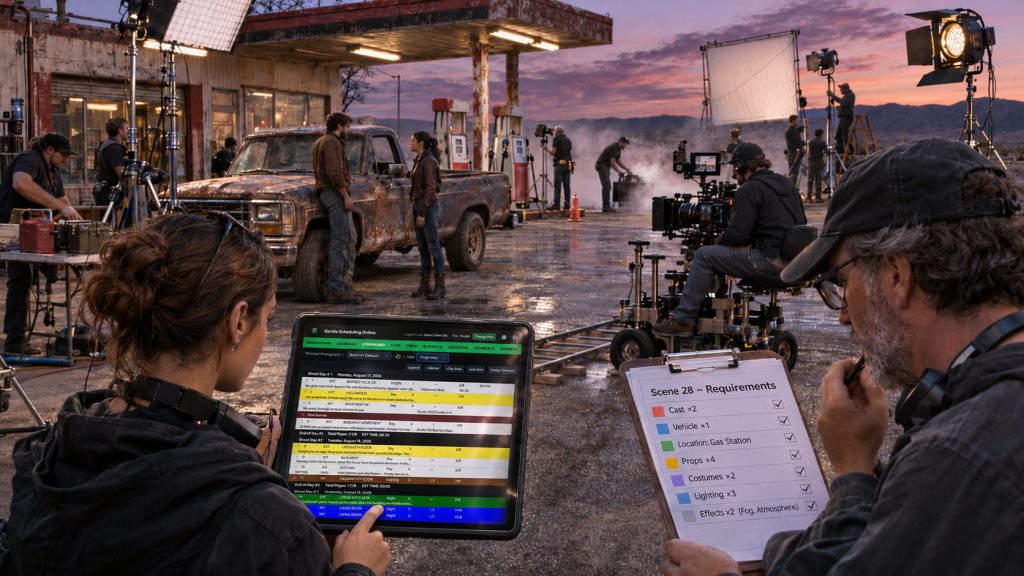
A screenplay describes what happens in a movie. A production schedule determines how that movie can actually be made.
Between those two documents lies one of the most important and time-consuming stages of pre-production: the script breakdown.
Someone must read every scene, identify the production elements, organize them into categories, and make sure nothing important is overlooked. The vintage car mentioned in an action line becomes a picture vehicle. A character’s bloodstained jacket becomes a wardrobe requirement. A crowded restaurant becomes a location with background actors, props, set dressing, and logistical challenges.
Traditionally, much of that information has been identified and tagged manually.
AI-assisted script breakdown offers a faster way to begin that work. But the real advantage comes when those suggested elements can become part of a practical shooting schedule.
Today, filmmakers can use AI to help analyze screenplay scenes, review proposed production elements, and prepare that information for scheduling software.
The result is a workflow that connects the creative material in the screenplay to the practical demands of production, while keeping the filmmaker responsible for the decisions that matter.
Why Script Breakdown Takes So Much Time
A screenplay can contain hundreds or even thousands of references to people, objects, locations, wardrobe, equipment, and special production requirements.
Some are obvious. Others are buried in seemingly ordinary action lines.
Consider this hypothetical scene:
EXT. ABANDONED GAS STATION – NIGHT
A battered pickup truck pulls beneath the flickering station lights. MARA steps out wearing a rain-soaked leather jacket, carrying a metal toolbox. Two armed security guards emerge from the shadows. As she opens the toolbox, a distant explosion lights the night sky.
It’s only a short paragraph, but a production breakdown might identify:
- Cast: Mara and two security guards
- Location: Abandoned gas station
- Vehicles: Battered pickup truck
- Wardrobe: Rain-soaked leather jacket and security guard uniforms
- Props: Metal toolbox and weapons
- Special Effects: Explosion and potentially atmospheric effects
- Lighting: Flickering station lights and explosion illumination
- Set Dressing: Gas pumps, signage, and surrounding station details
- Stunts and Safety: Potential requirements associated with weapons or explosions
That information needs to be reviewed, categorized, and tracked.
And the assistant director or production manager must repeat the process for every scene in the screenplay.
A feature-length script can require considerable attention before anyone begins arranging scenes into shooting days.
Related reading: — How to Break Down a Script for Film Production (Step-by-Step Guide)
What AI-Assisted Script Breakdown Actually Does
AI-assisted script breakdown software analyzes screenplay text and identifies references that may represent production elements.
Instead of requiring the user to manually highlight every mention of a prop, wardrobe item, or vehicle, the software can suggest relevant elements for review.
For our gas station scene, AI might identify the pickup truck, toolbox, leather jacket, security guards, and explosion.
Those suggestions provide an initial foundation for the breakdown.
However, a useful AI-assisted breakdown should do more than produce a long list of nouns.
It should help organize elements by scene and production category, allow users to correct the results, and make the approved information usable in a professional scheduling workflow.
A pickup truck should be identified as a vehicle, not merely a miscellaneous object. The metal toolbox should be categorized as a prop. The explosion may require special effects and additional planning.
The production team must also decide whether recurring objects represent the same physical item across multiple scenes.
AI can help recognize what appears in the screenplay. The filmmaker determines what the production actually needs.
Why Human Review Still Matters
An AI-generated breakdown should be considered a first pass, not a finished production document.
For example, the phrase “the room explodes with laughter” does not necessarily imply a special effect.
A character’s “old friend” isn’t a production prop.
A screenplay might describe a police car outside a building, but the production may intend to suggest its presence through flashing lights and sound rather than obtaining an actual vehicle.
Conversely, AI might identify an explosion without understanding the additional work required for permits, safety personnel, special effects equipment, rehearsals, and location preparation.
Experienced filmmakers consider the context behind every element.
They ask whether an item needs to be purchased, rented, fabricated, modified, duplicated, transported, or specially prepared.
They also identify requirements that aren’t explicitly stated in the screenplay.
A rainy exterior might require protective covers, additional lighting, drying equipment, and safety precautions even when none of those items appears in the action description.
This is why an effective AI-assisted breakdown workflow includes a review stage.
The user should be able to examine suggested elements, correct categories, remove false positives, add missing requirements, and approve the information before relying on it for production planning.
The goal is not to surrender the breakdown to artificial intelligence.
It’s to spend less time identifying the obvious elements and more time thinking about what each scene will require.
Two Ways to Use Breakdown Assistant AI
Jungle Software offers two ways to incorporate AI-assisted script breakdown into pre-production.
The first is a standalone web application designed for filmmakers who already use programs such as Final Draft or Movie Magic Scheduling.
The second is integrated into Gorilla Scheduling Online, allowing filmmakers to review AI suggestions and continue directly into the scheduling process.
Both approaches address the repetitive work involved in identifying screenplay elements, but they serve different production workflows.
Option 1: Breakdown Assistant AI Web
Breakdown Assistant AI Web is a standalone, browser-based script breakdown application.
It doesn’t require a Gorilla Scheduling subscription.
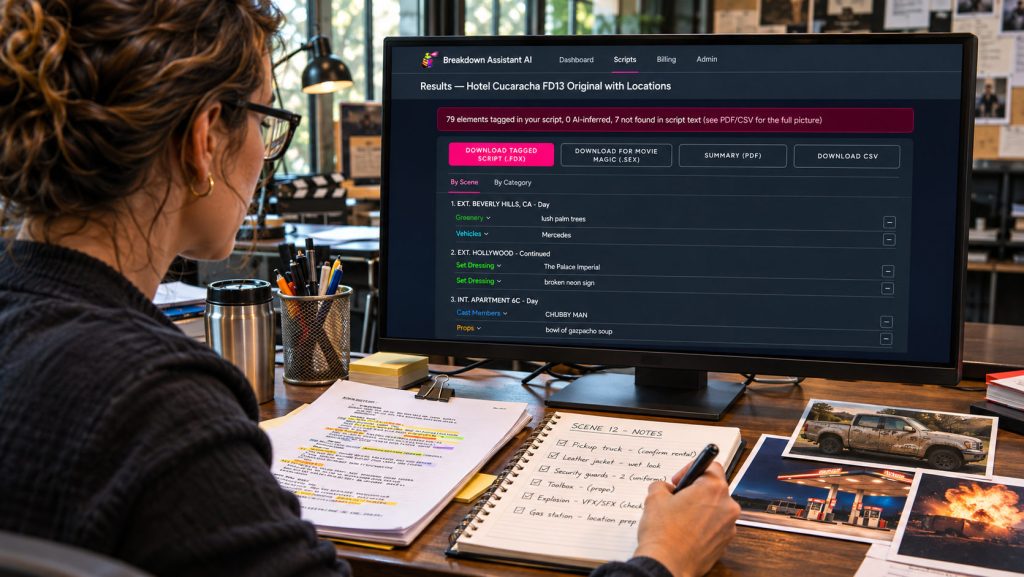
Filmmakers can upload a properly formatted screenplay, have AI analyze the scenes, review and edit the proposed elements, and export tagged screenplay information for use in compatible applications.
The process follows three main steps.
Step 1: Upload the screenplay.
Upload a Final Draft .fdx file or a PDF screenplay. The application supports scripts up to 150 pages.
Step 2: Review the AI-generated breakdown.
The application examines scenes and suggests elements such as cast, props, wardrobe, vehicles, set dressing, and other production requirements.
Users can review and edit the proposed tags and categories before exporting.
Step 3: Download the tagged results.
The web application supports tagged .fdx and .sex exports, along with PDF summary and CSV options.
Those files can be used with compatible screenwriting and scheduling applications, including Final Draft, Movie Magic Scheduling, and Gorilla Scheduling.
This makes the standalone version especially useful for filmmakers who want AI-assisted breakdown capabilities without changing their existing production software.
A Practical Example: AI Breakdown for Movie Magic Scheduling
Imagine an assistant director preparing a 110-page feature screenplay in Movie Magic Scheduling.
Traditionally, the assistant director might import the screenplay, examine every scene, and spend considerable time identifying and tagging individual production elements.
With Breakdown Assistant AI Web, the filmmaker can begin by uploading the screenplay and allowing AI to suggest the first round of elements.
After reviewing and correcting those suggestions, the filmmaker can download a tagged .sex file and import it into Movie Magic Scheduling.
The assistant director can then continue working with the familiar scheduling tools already used by the production.
The benefit is not that AI builds the entire shooting schedule.
It helps prepare the breakdown information that the assistant director will use to build that schedule.
Related reading: — Final Draft to Film Scheduling: How to Turn a Screenplay into a Shootable Schedule
Breakdown Assistant AI Web Pricing
The standalone application uses a pay-per-script model rather than requiring a monthly subscription.
A single full-script breakdown currently costs $19 for scripts up to 150 pages, with discounted multi-script packages available.
Filmmakers can also try the first 10 scenes free, including a downloadable tagged file, without providing a credit card.
That gives users an opportunity to review the results and test how the exported elements work with their scheduling software before purchasing a complete breakdown.
Try Breakdown Assistant AI Web: First 10 Scenes Free
Option 2: Breakdown Assistant AI Inside Gorilla Scheduling Online
For filmmakers using Gorilla Scheduling Online, AI-assisted breakdown becomes part of a broader pre-production workflow.
Instead of performing the breakdown in one application and importing the results into another, users can work with AI suggestions inside the scheduling environment.
The process begins with screenplay import.
Gorilla Scheduling Online supports Final Draft and PDF screenplay files. Once the scenes are imported, filmmakers can begin organizing the breakdown.
Breakdown Assistant AI can help identify potential production elements within those scenes.
The user reviews the suggestions and decides which elements belong in the breakdown.
Approved elements can then become part of the project’s production information, supporting the breakdown sheets and subsequent scheduling process.
This is where the distinction becomes important.
The standalone web application delivers a tagged screenplay file. The integrated Gorilla workflow continues from the approved breakdown into production scheduling.
That removes a separate export-and-import step for filmmakers already working in Gorilla Scheduling Online.
Breakdown Assistant AI and Gorilla Online Plans
Breakdown Assistant AI is included with the Production and Studio plans of Gorilla Scheduling Online.
The Solo plan includes 10 complimentary AI scene analyses, allowing individual filmmakers to explore AI-assisted breakdown within their scheduling workflow.
This provides different entry points depending on the size and needs of the production.
A filmmaker working independently can begin with Solo. Productions requiring collaboration and ongoing AI-assisted breakdown can use Production or Studio.
For current plan details and allowances, visit the Gorilla Scheduling Online product page.
From Approved Breakdown Elements to Production Strips
Once a screenplay has been broken down, the next task is turning the information into something the assistant director can actually schedule.
That begins with production strips.
A production strip represents a scene and provides information used to organize the shooting schedule.
Depending on the project, the strip can include the scene number, interior or exterior designation, location or set, day or night status, page count, and other scheduling information.
The breakdown adds important context.
Our gas station scene doesn’t simply represent a short nighttime exterior.
It involves a picture vehicle, security guards, specialized wardrobe, props, lighting effects, and an explosion.
Those requirements may influence how the scene is scheduled and what preparation is necessary before the cameras roll.
In Gorilla Scheduling Online, filmmakers can build production strips from their scenes and begin arranging them into shooting days on a digital stripboard.
The approved breakdown information remains useful throughout the scheduling process.
An AI suggestion that began as “pickup truck” can therefore become a production element the team needs to track, prepare, and account for.
This is where AI-assisted script breakdown begins delivering value beyond the initial tagging process.
Building a Shootable Schedule from the Breakdown
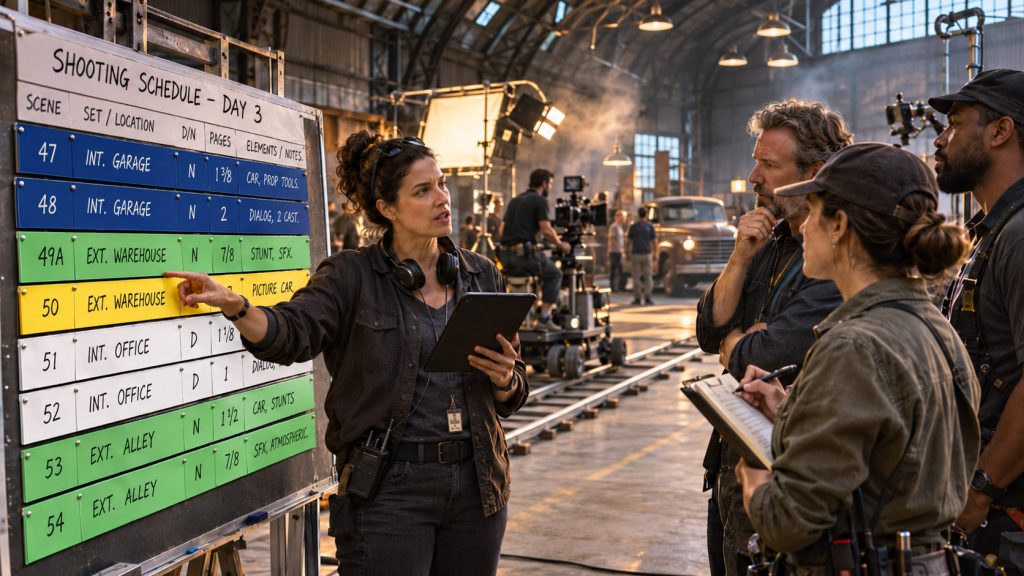
A screenplay is generally organized in story order.
A shooting schedule is organized according to production needs.
The assistant director may group scenes by location, cast availability, equipment requirements, daylight, or other logistical factors.
Consider three scenes that take place at our abandoned gas station.
In the screenplay, they may appear on pages 12, 48, and 96.
For production purposes, it may be more efficient to film them during the same location booking rather than returning to the gas station on three separate days.
The breakdown helps identify their shared requirements.
Perhaps all three scenes require the pickup truck. Two require the security guards. One requires the explosion.
The assistant director can examine those differences while determining which scenes should be grouped together and how much time to allow.
Gorilla Scheduling Online provides a digital stripboard for arranging scenes, building shooting days, and revising the schedule as production requirements change.
The software makes the information easier to organize and review.
But the assistant director still determines the most practical shooting order.
Related reading: — How to Read a Shooting Schedule
Why AI Breakdowns Don’t Automatically Produce Accurate Schedules
It’s tempting to imagine that AI could read a screenplay and immediately produce a perfect shooting schedule.
Real productions are more complicated.
A scene’s difficulty isn’t determined solely by how many elements appear in it.
A simple conversation may take hours because the director wants elaborate camera coverage, difficult blocking, or several lighting setups.
An action sequence may require extensive rehearsals, safety procedures, and equipment preparation even when the screenplay describes it in only a few lines.
Cast availability, location restrictions, union requirements, transportation, weather, and budget constraints also influence the scheduling process.
These factors often exist outside the screenplay.
AI-assisted breakdown can help identify production elements, but it cannot independently resolve every scheduling decision.
The most useful approach is to combine AI-generated suggestions with professional scheduling tools and experienced production judgment.
Let AI assist with the first pass.
Let the production team decide how the film should be made.
AI Breakdown and Production Budgeting
An accurate script breakdown also provides valuable information for budgeting.
Every production element can carry a potential cost.
The pickup truck may require rental fees, transportation, fuel, and insurance.
The security guards may require cast payments, wardrobe, and equipment.
The gas station location may involve rental fees, permits, power, parking, and restoration.
The explosion may require special effects personnel, equipment, safety arrangements, and additional preparation time.
Once these requirements have been identified and the shooting schedule begins to take shape, the producer can develop a more informed budget.
Gorilla Budgeting Online provides a professional environment for organizing production accounts, calculating estimated costs, managing labor-related expenses, and generating budget reports.
The scheduling and budgeting workflows can be reviewed together, helping filmmakers understand how their creative and logistical decisions affect the financial plan.
AI doesn’t determine what these elements will cost. Actual quotes, rates, agreements, and production assumptions are still necessary.
But an organized breakdown helps ensure the producer knows which expenses need to be considered.
Related reading: — From Script to Schedule to Budget: A Modern Pre-Production Workflow
Related reading: — Why Online Film Budgeting Still Needs Professional Budget Structure
What About Storyboards and Shot Lists?
Script breakdown identifies the production elements required for a scene.
Shot planning determines how that scene will be photographed.
These are related but distinct stages of pre-production.
For our gas station sequence, the director might plan an establishing wide shot, a moving shot of the pickup truck, a close-up of Mara opening the toolbox, and several angles involving the security guards.
Each setup creates additional requirements involving camera placement, lenses, lighting, equipment, and crew time.
Shot Monkey provides an online environment for planning those shots through storyboards, shot lists, camera setups, camera movement overlays, and AI-assisted storyboard imagery.
Reviewing the shot plan alongside the shooting schedule can help the production team better understand how much work the scene will involve.
AI-assisted breakdown helps identify what the production needs.
Shot planning helps determine how the director intends to capture it.
Scheduling brings those requirements together into a practical shooting plan.
Related reading: — Storyboard and Shot List Software: Plan Every Shot Before You Shoot
Choosing Between Standalone AI Breakdown and Integrated Online Scheduling
The right workflow depends on the tools a filmmaker already uses and the scope of the production.
Breakdown Assistant AI Web is particularly suitable for filmmakers who work in Movie Magic Scheduling, Final Draft, or another compatible application and want to accelerate the initial tagging process.
It provides a straightforward way to upload a screenplay, review AI suggestions, and export tagged results without adopting a new scheduling platform.
Gorilla Scheduling Online is designed for filmmakers who want the screenplay breakdown and scheduling process to take place in the same browser-based environment.
With Breakdown Assistant AI available inside Gorilla Online, approved elements can support the next stages of production planning without a separate file transfer.
Both approaches serve a practical purpose.
The goal isn’t to replace professional production planning.
It’s to reduce repetitive breakdown work and give filmmakers a stronger foundation for the work that follows.
| Feature | Breakdown Assistant AI Web | Gorilla Scheduling Online |
|---|---|---|
| Requires Gorilla | No | Yes |
| Script input | FDX or PDF | FDX or PDF |
| AI element suggestions | Yes | Yes |
| User reviews suggestions | Yes | Yes |
| Output | Tagged FDX/SEX, PDF, CSV | Approved elements in Gorilla breakdown |
| Scheduling included | No | Yes |
| Pricing model | Pay per screenplay | Included in Production/Studio |
| Free AI usage | First 10 scenes | 10 complimentary scene analyses with Solo |
The standalone web application currently offers a $19 single-screenplay breakdown, with discounted packages for multiple scripts. Breakdown Assistant AI
A Better Balance Between AI and Filmmaking Experience
The most valuable application of AI in pre-production may not be making the final decisions.
It may be helping filmmakers reach those decisions with better-organized information.
A screenplay can contain hundreds of details that someone must recognize and track. AI-assisted analysis can help reveal those details, while the filmmaker determines which ones are relevant and how they should be handled.
Scheduling software then provides the structure needed to organize scenes, production elements, locations, cast, shooting days, and reports.
Together, these tools can make pre-production more efficient without sacrificing the experience and judgment required to make a film.
And that is the real opportunity.
AI helps identify what is in the script. The filmmaker decides what it means for the production. The schedule determines how the work gets done.
Get Started with AI-Assisted Script Breakdown
Whether you’re preparing an independent feature, short film, commercial, or larger production, AI-assisted breakdown can help streamline the transition from screenplay to shooting schedule.
Already using Final Draft or Movie Magic Scheduling?
Try Breakdown Assistant AI Web. Analyze your first 10 scenes free, review the suggested production elements, and download a tagged file for your existing workflow.
Want AI-assisted breakdown built into your scheduling software?
Explore Gorilla Scheduling Online, where screenplay breakdowns, production strips, digital stripboards, shooting days, and scheduling reports are part of one online production environment.
The best technology doesn’t make filmmaking decisions for you. It gives you more time and better information to make those decisions yourself.