
What Is a Stripboard in Film Production? (Complete Guide)
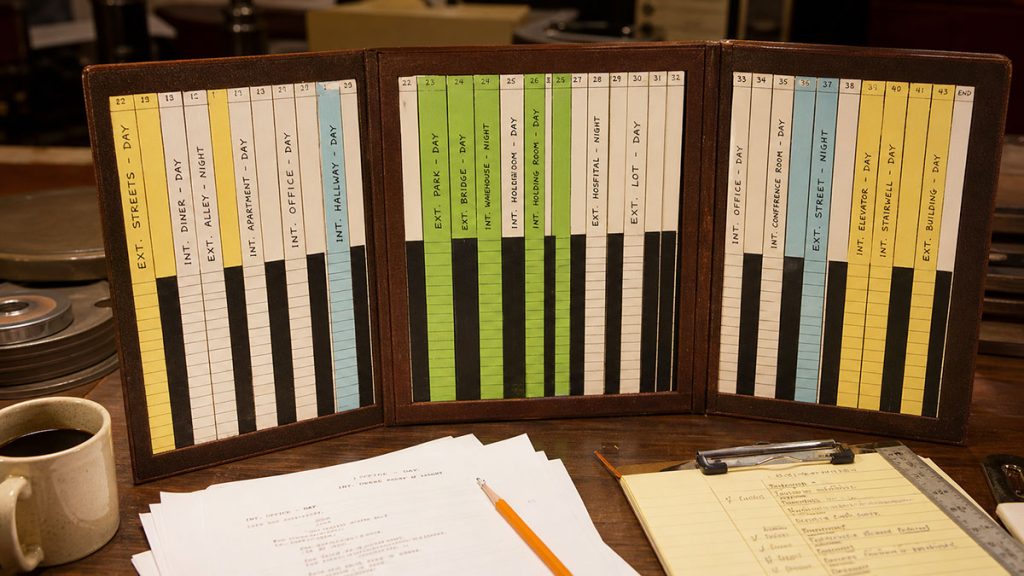
If you’ve ever wondered how professional film productions turn a script into a structured shooting schedule, the answer often comes down to one essential tool: the stripboard.
What you are looking at above is a AI generated (sue me…) but a visual representation of what a ‘vintage stripboard’ used to look like in the days of old Hollywood. In all honesty — I remember these in film school — so — maybe not too old. 🙂
A stripboard is the visual backbone of a film schedule. It allows filmmakers to organize scenes, optimize shooting days, and manage complex productions in a way that’s both flexible and efficient.
In this guide, we’ll break down exactly what a stripboard is, how it works, and why it’s one of the most important tools in film production planning.
What Is a Stripboard?
A stripboard is a visual scheduling tool used in film and television production to organize scenes into a shooting schedule.
Each scene is represented as a horizontal “strip” that contains key information such as:
- Scene number
- Location
- Time of day (day/night)
- Page count
- Cast requirements
These strips can be rearranged to build an efficient shooting schedule that minimizes time, cost, and logistical complexity.
👉 Related: What Is a Production Strip in Film Scheduling?
Why Stripboards Are Essential in Film Production
A stripboard does more than organize scenes — it provides a way to see your entire production at a glance.
Without a stripboard, scheduling becomes:
- rigid
- difficult to adjust
- prone to costly inefficiencies
With a stripboard, filmmakers can:
- group scenes by location
- reduce company moves
- balance workloads across shooting days
- quickly adapt to changes
In short, it transforms scheduling from guesswork into a structured system.
What Information Is Included on a Strip?
A standard strip contains several key pieces of information:
- Scene number
- Interior or exterior (INT/EXT)
- Location name
- Day or night
- Script page length
- Cast involved
Color-coding is often used to represent different types of scenes (for example, day vs night), making it easier to scan the schedule quickly.
Understanding Stripboard Colors (Day, Night, Interior, Exterior)
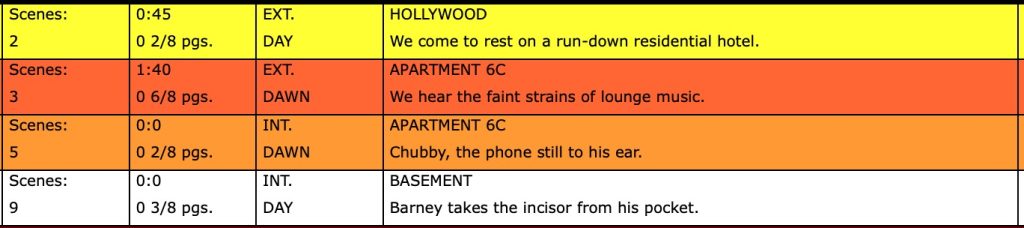
Traditionally, stripboards use standardized color conventions to represent different scene types:
- EXTERIOR DAY → Yellow (representing sunlight)
- INTERIOR DAY → White
- EXTERIOR NIGHT → Blue
- INTERIOR NIGHT → Dark Blue
These color distinctions allow the production team to quickly identify when scenes take place and what type of setup is required. For example, a schedule filled with yellow strips immediately signals a heavy exterior day shoot, while dark blue strips indicate night work, which often requires more complex lighting setups.
Additional Colors? Absolutely! Most scheduling programs, like Gorilla Scheduling, allow you to add colors to other times of day, like AFTERNOON, SUNSET, MIDNIGHT, etc. You can also customize the colors depending on the schedule.
Why Color Consistency Matters
While modern film scheduling software allows you to customize strip colors — for example, changing day scenes to pink or using custom palettes — consistency is far more important than personalization.
The purpose of stripboard colors is not creativity — it’s clarity.
Crew members, assistant directors, and department heads rely on these visual cues to quickly interpret the schedule. If colors are inconsistent or non-standard, it can lead to confusion, miscommunication, and costly delays.
Maintaining a consistent color system ensures that:
- Everyone on set understands the schedule instantly
- Time-of-day requirements are clear
- Lighting and setup needs can be anticipated in advance
Time of Day vs Time of Shoot
One important distinction that stripboard colors communicate is the difference between:
- When a scene is shot
vs - When a scene takes place
For example, a night scene (dark blue) might be filmed during the day using controlled lighting. However, the stripboard reflects the story time, not the shooting time.
This is critical because it informs:
- lighting design
- equipment needs
- production planning decisions
In other words, stripboard colors represent the world of the story, not the clock on the call sheet.
Advanced Use of Color in Modern Scheduling
Experienced filmmakers sometimes expand beyond the basic color system to add additional layers of meaning.
For example:
- Highlighting priority scenes
- Marking complex setups (stunts, VFX)
- Flagging scenes with specific logistical challenges
However, even with these enhancements, the core day/night and interior/exterior color conventions should remain intact. These are the universal “language” of stripboards that professionals recognize instantly.
How Stripboards Improve Scheduling Efficiency
One of the biggest advantages of a stripboard is the ability to optimize your schedule visually.
For example:
- Grouping all scenes at one location reduces travel time
- Scheduling similar lighting conditions together saves setup time
- Minimizing company moves reduces costs
Ok, I need to make you stop for a second and read this part right here:
SORT YOUR STRIPS BY LOCATION! — (NOT BY SET)
I’ve written an entire blog on this subject alone because it is soooo important! After you read this article, take a look at this one: Set vs. Location on the Stripboard.
A well-organized stripboard can shave entire days off a production schedule — which directly impacts your budget.
The Relationship Between Stripboards and Film Scheduling Software
Traditionally, stripboards were created using physical boards and paper strips.
Today, most productions use digital tools that replicate and enhance this process.
Modern film scheduling software allows filmmakers to:
- Drag and drop strips instantly
- Automatically update schedules
- Integrate scheduling with budgeting
Tools like Gorilla Scheduling are built around this concept, allowing filmmakers to create, adjust, and optimize stripboards in a much more efficient way than manual methods.
Advanced Stripboard Techniques: Page Count, Pacing, and AD Strategy
Once you understand the basics of stripboards, the next level is learning how to use them as a tool for managing time, pacing, and efficiency on set.
Experienced assistant directors don’t just arrange scenes — they use stripboards to predict how a day will unfold and where problems might arise.
And guess what? Things change. What? They do?? Yes.
Your schedule must adapt to these changes (see Contingency below…).
The 1/8 Page Rule (Estimating Workload)
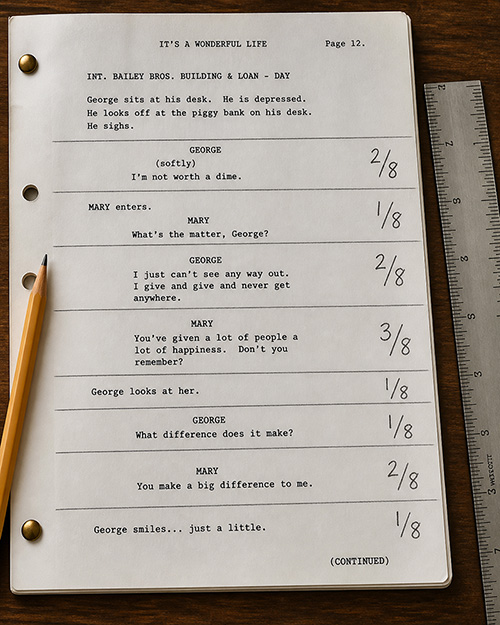
Yeah… I remember this… that’s how you used to do before screenplay programs.
In film production, script length is often measured in eighths of a page.
A single page of a screenplay is divided into 8 sections, allowing for more precise scheduling. For example:
- A short scene might be 2/8 of a page
- A longer scene might be 6/8 or a full page (8/8)
This measurement helps estimate how much can realistically be shot in a day.
As a general guideline:
- 3–5 pages per day is typical for many productions
- More complex scenes (action, stunts, heavy dialogue) reduce that number
However, page count alone doesn’t tell the full story. A 1-page dialogue scene might take less time than a 2/8 action sequence with multiple setups.
Pacing Your Shooting Days
A strong stripboard doesn’t just organize scenes — it balances the rhythm of your shoot.
Experienced ADs avoid:
- Overloading a single day with too many setups
- Scheduling multiple complex scenes back-to-back
- Ignoring crew fatigue and turnaround time
Instead, they aim to:
- Mix lighter and heavier scenes within a day
- Build a realistic flow of work
- Leave room for delays or unexpected issues
This is where stripboards become more than a planning tool — they become a predictive system.
Company Moves and Hidden Time Costs
One of the biggest scheduling inefficiencies is the company move — when the entire production shifts from one location to another.
Even a short move can take hours when you factor in:
- equipment breakdown and setup
- travel time
- re-lighting and staging
A well-structured stripboard minimizes company moves by grouping scenes in the same location together.
Reducing even one company move can save:
- significant time
- crew overtime
- equipment costs
Scheduling for Real-World Constraints
Professional stripboards account for more than just the script — they incorporate real-world limitations such as:
- Actor availability
- Location restrictions
- Weather conditions
- Union rules and turnaround requirements
For example, a location might only be available for one day, forcing multiple scenes to be scheduled together regardless of script order.
An experienced AD uses the stripboard to solve these constraints while still maintaining efficiency.
Thinking Like an Assistant Director
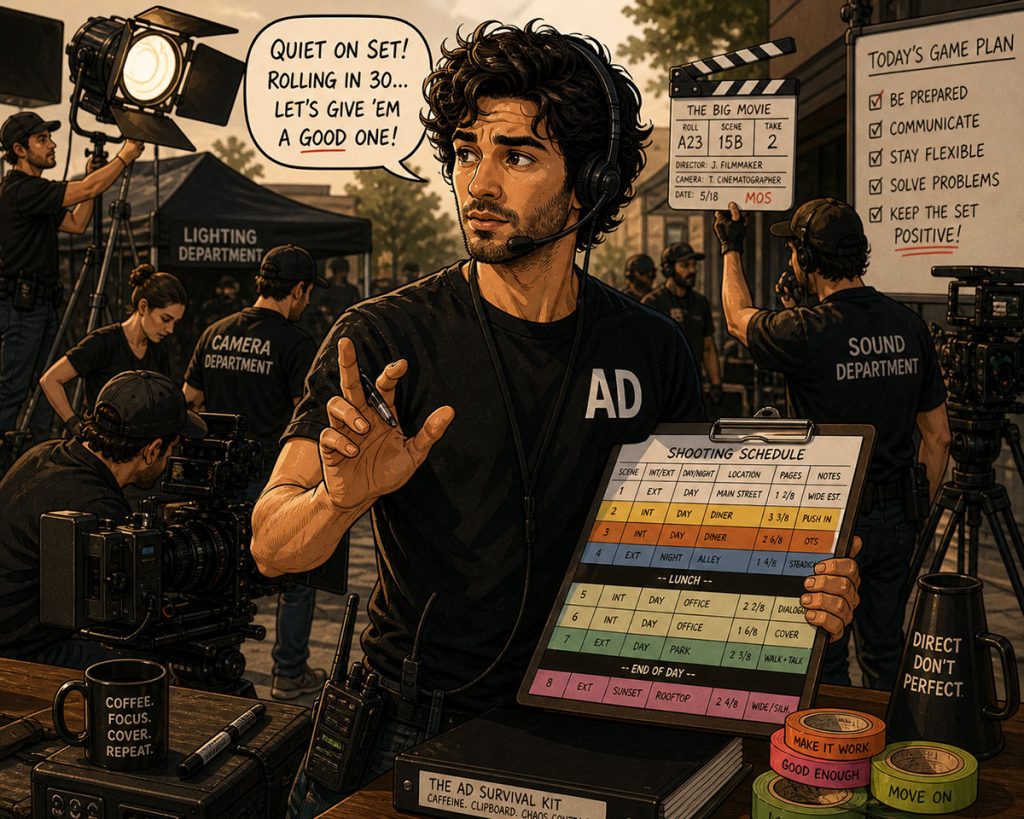
At the highest level, a stripboard is not just about organizing scenes — it’s about thinking ahead.
A good stripboard answers questions like:
- Where are we likely to fall behind?
- Which days are too ambitious?
- Where do we need flexibility?
This proactive approach is what keeps productions on schedule and on budget.
Stripboard vs Shooting Schedule: What’s the Difference?
A stripboard is the tool used to build a schedule.
A shooting schedule is the final output.
Think of it this way:
- Stripboard = planning system
- Shooting schedule = execution plan
Without a stripboard, building an effective schedule becomes significantly more difficult.
Are you asking what is a shooting schedule? Can you show me what that looks like? Yup.
Take a look at this article: What exactly is a Shooting Schedule (and how can I create one)?
Common Mistakes When Using Stripboards
Even though stripboards are incredibly powerful tools, they’re only as effective as the way they’re used. Inexperienced filmmakers often fall into a few common traps that can quietly undermine an otherwise solid schedule.
One of the biggest mistakes is scheduling scenes strictly in script order. While it may feel logical to follow the story as written, production doesn’t work that way. A script might jump between locations, times of day, and setups that are inefficient to shoot sequentially. A well-built stripboard reorganizes the story for production efficiency — grouping scenes by location, lighting requirements, and cast availability.
Another frequent issue is failing to properly group scenes by location. Every time a production moves from one location to another, it triggers a cascade of delays: equipment must be packed up, transported, reassembled, and relit. These “company moves” are often underestimated, but they can consume hours of valuable shooting time. A strong stripboard minimizes these moves by clustering scenes in the same location whenever possible.
Overloading shooting days is another subtle but costly mistake. On paper, a day might look manageable based on page count alone, but that doesn’t always reflect reality. Complex scenes, multiple setups, or demanding performances can slow things down significantly. When too much is packed into a single day, the result is often overtime, rushed work, or scenes being pushed to later days — all of which impact both morale and budget.
Finally, one of the most overlooked issues is treating the stripboard as a static document. In reality, a stripboard should evolve throughout pre-production and even during the shoot. Conditions change — weather shifts, actors become unavailable, locations fall through — and the schedule needs to adapt accordingly. Failing to update the stripboard in response to these changes can quickly lead to confusion and inefficiency on set.
Avoiding these pitfalls doesn’t just make your schedule cleaner — it can have a direct impact on the success of your production. A well-maintained stripboard keeps your shoot organized, your crew aligned, and your budget under control.
How Stripboards Connect to Budgeting
Stripboards don’t just affect your schedule — they directly impact your budget.
Every scheduling decision influences costs such as:
- crew wages
- equipment rentals
- location fees
For example, reducing shooting days through efficient stripboard planning can dramatically lower your overall production budget.
This is why many filmmakers use tools that combine film scheduling and budgeting software, allowing changes in the stripboard to immediately reflect in the budget.
Continue Learning Film Production Planning
If you’re diving deeper into production planning, understanding how stripboards connect to scheduling and budgeting is essential.
You may also find these guides helpful:
- How to Schedule a Film Shoot
- Film Budget Template (Free Guide)
- What Is a Crew Deal Memo (And Why It Can Save Your Production)
- How to Write a Filmable Screenplay
- What Is a Call Sheet in Film? (Free Download)
- Film Budget Categories Explained
- How a Shooting Schedule Impacts Your Film Budget
- What Is a Production Strip in Film Scheduling?
- How to Turn a Script Breakdown Into a Film Budget
Together, these form the foundation of an efficient, well-organized production.
Final Thoughts
Ok, guys — this is a lot — I know —
Understanding what a stripboard is — and how to use it effectively — is one of the most important skills in film production.
It’s not just a scheduling tool. It’s a system for organizing your entire production in a way that saves time, reduces costs, and keeps your project on track.
Whether you’re working on a small independent film or a large-scale production, mastering stripboards will give you a significant advantage.
Questions or Comments?
Have a question about stripboards or film scheduling? Feel free to leave a comment below — or reach out if you want to learn more about how professional tools can streamline your workflow.