
The Three-Act Structure for a Screenplay: Setup, Confrontation, and Resolution
Why do some stories pull us effortlessly from one scene to the next while others lose momentum halfway through? Understanding three-act structure helps writers shape conflict, character change, and a satisfying ending without turning storytelling into a mathematical formula.
What Is the Three-Act Structure?
The three-act structure is a way of organizing a dramatic story into a beginning, middle, and end. In screenplay terms, those acts are usually called Setup, Confrontation, and Resolution. Each one answers a different dramatic question: Who are we following and what disrupts their world? What stands between them and their goal? And what happens when they finally confront the central conflict?
That sounds simple, and it is. The difficult part is making each event cause the next. A film does not become compelling merely because a major event occurs on page 25 and another one occurs on page 90. Those events matter because they change what the character wants, what they risk, or what they believe.
Our earlier guide emphasized that structure places the right event at the right moment. That's still a useful way to think about it, provided the story's emotional logic determines those moments rather than a stopwatch.
Introduce the protagonist, establish the world and the stakes, and push the character toward a consequential choice.
Escalate obstacles, test relationships, raise the cost of failure, and transform the character's understanding of the problem.
Bring the conflict to its decisive confrontation and show the consequences of the character's choices.
Visualizing the Three Acts
For a hypothetical 120-page feature, a common teaching model allocates about 30 pages to Act I, 60 to Act II, and 30 to Act III. The diagram below illustrates that structure and its major turning points. These are guidelines, not mandatory page counts. Short features, comedies, dramas, and unconventional narratives frequently move at different rhythms.
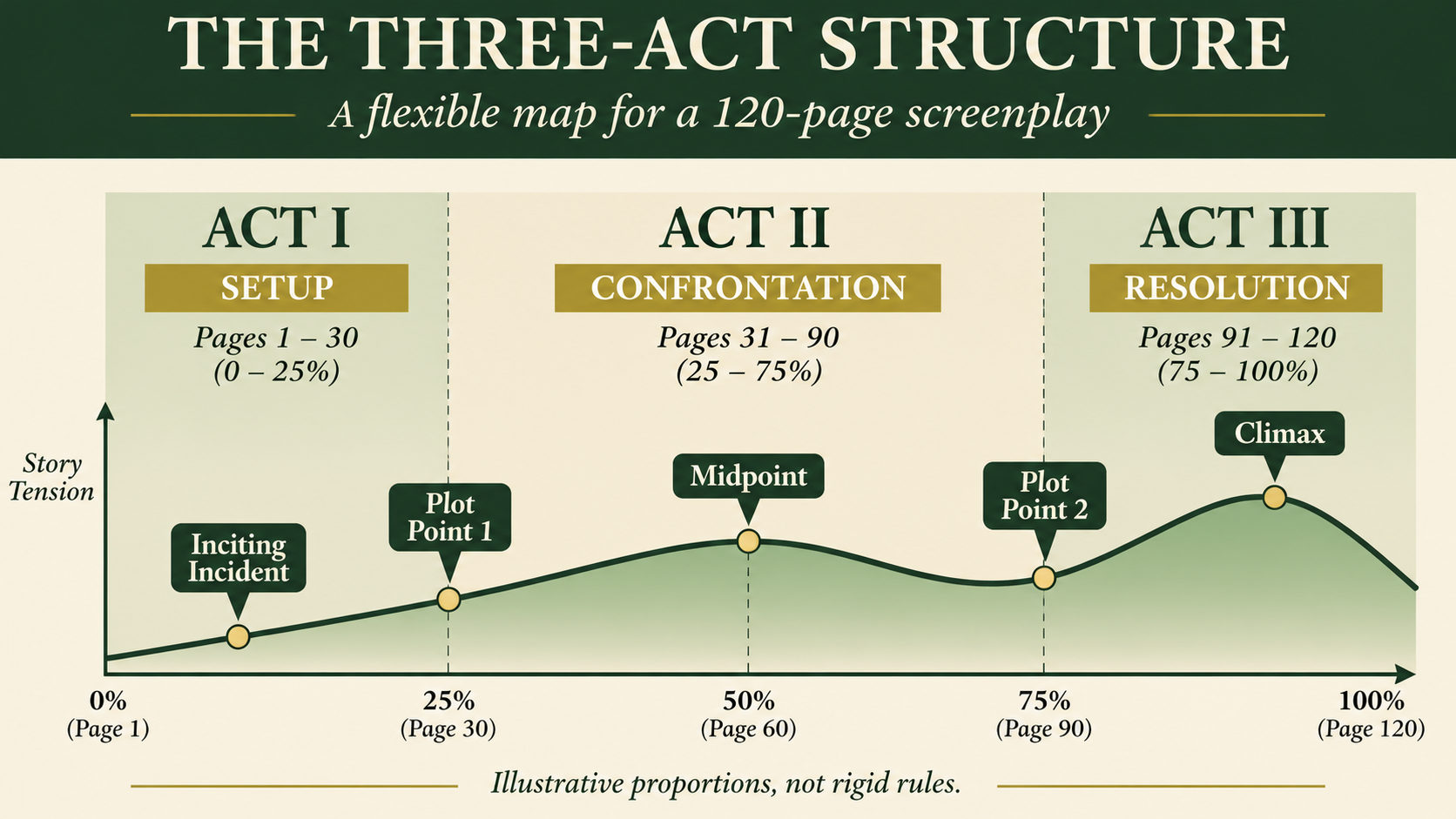
The percentages describe story progression, not a literal graph of a movie's emotional intensity. The story may rise, fall, surprise us, or slow down within each act.
Act I: Setup | Give the Audience a Reason to Care
Act I introduces the protagonist in a recognizable situation. We discover what they want, what is missing, and the pressures that shape their choices. Then an event unsettles the status quo. Often called the inciting incident, it creates an opportunity, a problem, or a threat that the character cannot simply ignore.
By the end of the first act, a major turning point typically commits the protagonist to a new course of action. Their familiar world has changed, and the central story is underway.
The Lighthouse Keeper
Mara, an isolated lighthouse keeper, has spent years refusing contact with her estranged brother. During a fierce storm, she receives a distress signal from a boat carrying him. The signal is the inciting incident. When the harbor authorities refuse to launch a rescue, Mara takes her own small vessel into the storm. That decision becomes her first-act turning point.
An effective opening doesn't need an explosion, chase, or spectacular event. A quiet conversation can alter a character's life just as dramatically. What matters is that the story begins creating expectations and consequences.
For help constructing a protagonist with clear goals and contradictions, see How to Develop a Main Character for Your Screenplay.
Act II: Confrontation | Make Every Choice More Difficult
Act II is usually the largest part of a feature screenplay, and often the hardest to write. The protagonist pursues their objective, encounters resistance, adapts, makes mistakes, and sometimes discovers that the original goal was not the whole problem.
It is tempting to write the middle as a chain of similar obstacles: the character tries, fails, tries again, and fails again. But repetitive difficulty is not the same as rising dramatic tension. Strong scenes change the situation. An apparent victory might trigger a worse crisis; a new ally may have a conflicting agenda; a secret may force the protagonist to reconsider everything.
The midpoint: a shift in the story's direction
Near the middle, a revelation, reversal, success, or devastating failure often changes how the protagonist understands the conflict. It doesn't have to occur on precisely page 60. Its job is to make the second half of the movie feel different from the first.
Mara locates the missing boat but discovers its radio was damaged hours ago. The distress signal was transmitted from somewhere else. What began as a rescue becomes a mystery, and she must choose whether to continue searching despite dwindling fuel and worsening weather.
End of Act II: the crisis
Near the end of Act II, the protagonist faces a major reversal that makes the objective appear impossible or demands a painful new choice. This moment prepares the final act, where the character must act with what they have learned.
Supporting characters can intensify the dilemma instead of merely delivering information. Our guide to developing supporting characters explores how relationships create both pressure and possibility.
Act III: Resolution | Make the Climax Mean Something
The final act brings the central conflict to a decisive point. The protagonist's earlier decisions, flaws, strengths, and relationships should all matter here. Whether the ending is hopeful, tragic, or unresolved, it should feel like a consequence of the story we have watched.
The climax is not necessarily the biggest action sequence. It is the dramatic event where the central question is finally answered. A character choosing to tell the truth can be more consequential than a physical battle.
Mara realizes that the false distress signal was a deliberate attempt to draw rescuers away from a dangerous shipping channel. She can continue searching for her brother or return to warn the harbor of a vessel heading toward the rocks. Her choice resolves not only the external danger but also the question of whether she can put others' lives before her unresolved family conflict.
After the climax, allow enough space for the audience to register what has changed. The resolution may be only a few moments, but its emotional effect should be earned.
Turning Points, Inciting Incidents, and Why They Matter
| Story moment | Typical function | Question for the writer |
|---|---|---|
| Inciting incident | Disrupts the ordinary world | Why can't life simply continue as before? |
| First act turning point | Commits the protagonist to the central journey | What decision or event changes the story's direction? |
| Midpoint | Alters the protagonist's knowledge, strategy, or stakes | Why is the conflict different after this? |
| Second act turning point | Creates a crisis that demands the final confrontation | What does the protagonist now have to face? |
| Climax | Answers the central dramatic question | What final action reveals who this character has become? |
What Influential Screenwriting Teachers Say About Structure
Syd Field: a practical dramatic paradigm
In Screenplay: The Foundations of Screenwriting, Syd Field popularized an approach built around Setup, Confrontation, and Resolution, with major plot points linking the acts. His Paradigm Worksheet places the turning points around pages 20–30 and 80–90 in a conventional feature, with a midpoint around page 60. For developing writers, the framework provides useful landmarks, not an excuse to make every story identical.
Robert McKee: meaningful changes within scenes
In Story, Robert McKee examines structure through conflict and meaningful changes in the conditions of characters' lives. His approach encourages writers to ask not only what happens in a scene, but what changes because it happens. A screenplay can hit familiar plot points and still feel lifeless if its individual scenes don't alter the stakes. See McKee's discussion of scene turns.
John Truby: develop the story from character and moral choices
John Truby, author of The Anatomy of Story, offers a more character-centered alternative to rigid three-act outlines. His framework uses interconnected development steps including desire, opponents, moral argument, self-revelation, and scene construction. Truby's work is a valuable reminder that a narrative's structure grows out of the protagonist and the world, not only out of prescribed page numbers. Explore The Anatomy of Story.
These approaches are not mutually exclusive. You might use Field to see the big picture, McKee to strengthen individual scenes and turning points, and Truby to deepen character motivation and thematic design.
Three-Act Structure in Familiar Movies
Films don't always follow the framework precisely, and interpretations can differ. The examples below illustrate how a viewer might identify the central dramatic progression, not an officially declared three-act outline from the filmmakers.
Jaws (1975): a clear external threat
Setup: The shark attacks create a danger the community wants to ignore. Confrontation: Chief Brody's attempts to protect the town escalate, ultimately sending him out to sea with Hooper and Quint. Resolution: The confrontation on the boat forces Brody into a final, life-or-death response. The story moves from recognizing the problem to confronting it directly.
The Wizard of Oz (1939): a change of world and desire
Setup: Dorothy's dissatisfaction and the tornado take her into Oz. Confrontation: Her journey to the Wizard brings allies, obstacles, and the Wicked Witch's pursuit. Resolution: Dorothy discovers how to return home, reinterpreting what she wanted all along. The fantasy's emotional structure is inseparable from Dorothy's changing perspective.
The Godfather (1972): a protagonist's moral transformation
Setup: Michael Corleone initially sees himself as separate from the family business. Confrontation: Violence and family loyalty pull him deeper into the conflict. Resolution: He consolidates power and emerges transformed, making the ending less a simple victory than a profound moral reversal. The dramatic arc operates through character decisions as much as external events.
How to Outline Your Screenplay in Three Acts
Before drafting, write a short paragraph describing your protagonist, the external goal, the opposing force, and the emotional problem underneath the action. Then sketch the major changes in the story.
- Write the central dramatic question. What will the audience want to know by the end?
- Identify the inciting incident. What disrupts the protagonist's life?
- Choose the first major turning point. What launches the central conflict?
- Develop escalating complications. Each significant scene should change the situation or the protagonist's understanding.
- Find a meaningful midpoint. What truth, reversal, or choice changes the nature of the conflict?
- Create the Act II crisis. What forces a final, difficult choice?
- Design the climax and aftermath. How is the dramatic question answered, and what does it cost?
Remember that a three-act outline is a working document. A character's behavior may surprise you during drafting. Revise the outline when a better causal path emerges rather than forcing every scene to obey your first plan.
Plan and Write Your Three-Act Screenplay with Page One
Story structure becomes easier to manage when you can see the entire screenplay rather than scrolling through dozens of pages. Page One, Jungle Software's online screenwriting application, includes index cards, scene navigation, named sequences or acts, and a split view so you can move between your outline and the script.
You can build an index card for each scene, note its dramatic purpose, and rearrange cards as the story changes. Character biographies and relationship tools help you track how the protagonist and supporting cast develop across the three acts. When it's time to prepare for filming, Page One also provides screenplay tagging and a path to Gorilla Scheduling Online through an on-demand two-way synchronization workflow, subject to plan features.
Other established screenwriting applications, including Final Draft, Movie Magic Screenwriter, Fade In, and WriterDuet, can also help you draft and organize a screenplay. The best tool is one that makes it easier to concentrate on the story, revise intelligently, and deliver a properly formatted script.
Three-Act Structure Revision Checklist
- Can a reader identify what the protagonist wants?
- Does the inciting incident create a meaningful disruption?
- Does the first turning point commit the protagonist to a different path?
- Do events in the middle escalate or transform the central conflict?
- Does the midpoint change knowledge, stakes, or strategy?
- Are supporting characters motivated by goals of their own?
- Does the Act II crisis force a difficult choice?
- Does the climax emerge from earlier actions and character development?
- Does the ending resolve or deliberately reframe the central dramatic question?
- Can you remove a scene without changing the story? If so, ask what that scene contributes.
Turn Your Story Outline into a Screenplay
Whether you're writing your first short film or revising a feature, three-act structure can help clarify the journey without limiting your imagination. Develop characters, organize scenes, and turn your outline into a formatted screenplay with Page One.
Continue Learning
How to Develop a Main Character · How to Develop Supporting Characters · Proper Screenplay Format · Guide to the Preproduction Process
Further reading: Syd Field, Screenplay; Robert McKee, Story; John Truby, The Anatomy of Story. The linked educational materials above provide additional background; the film interpretations and original story examples in this article are editorial illustrations.