
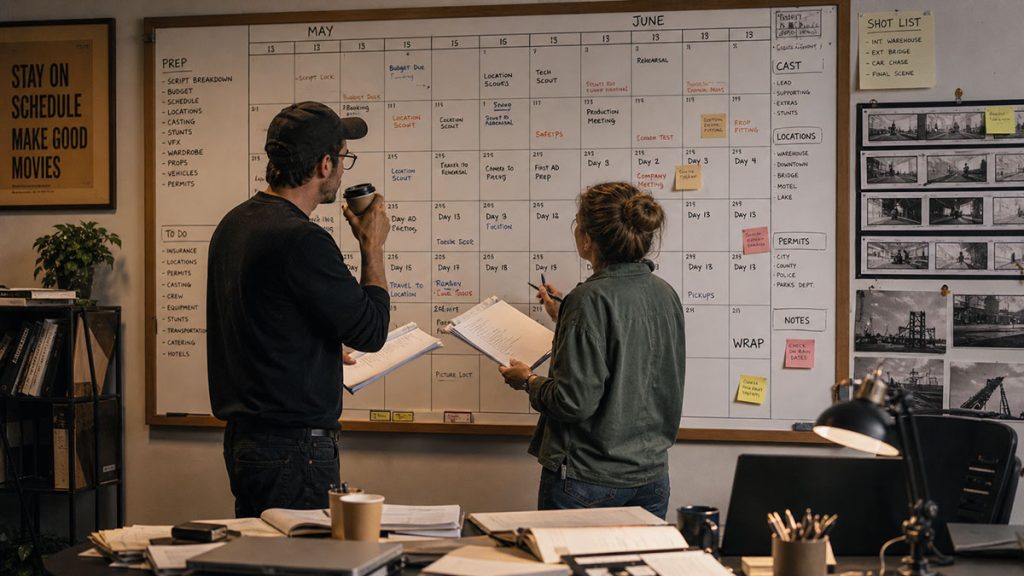
Before a film set comes alive, before the first call sheet lands in anyone’s inbox, and before the assistant director starts counting daylight like it is treasure, the production needs a calendar.
Not just a list of shoot days.
A real production calendar.
A film production calendar is the master timeline that organizes everything needed to move a project from script to shoot to wrap. It tracks the dates, deadlines, prep work, production milestones, cast availability, location windows, rehearsals, tech scouts, equipment rentals, permits, budget checkpoints, and the many invisible decisions that keep a film from turning into a beautiful disaster with snacks.
A shooting schedule tells you what scenes you are filming and when.
A production calendar tells you how the entire production gets ready to film those scenes in the first place.
For filmmakers, producers, assistant directors, and screenwriters, understanding the production calendar is a major step toward understanding how a movie becomes real. It is where the creative vision starts meeting dates, departments, money, people, weather, locations, contracts, and time.
In other words, it is where the movie starts putting on its work boots.
What Is a Production Calendar?
A production calendar is a planning document that lays out the full timeline of a film or video project.
It usually begins before filming starts and continues through production, wrap, and sometimes post-production. Depending on the size of the project, it may track a few weeks of work or several months of moving parts.
A production calendar can include:
- Pre-production start date
- Script breakdown deadline
- Budget deadlines
- Casting dates
- Location scouting
- Tech scouts
- Rehearsals
- Wardrobe fittings
- Props and set dressing deadlines
- Permit deadlines
- Equipment rental dates
- Production meetings
- Table reads
- Shoot dates
- Company moves
- Wrap dates
- Post-production milestones
The exact details vary by production, but the purpose stays the same: the calendar gives everyone a shared view of what must happen, when it must happen, and how much time the team has before cameras roll.
A production calendar is especially valuable because film production is not one job. It is a stack of interdependent jobs pretending to be one job.
Casting affects rehearsals.
Locations affect permits.
Permits affect the shooting schedule.
The shooting schedule affects the budget.
The budget affects what can be rented, built, hired, moved, cut, rewritten, or saved for another day.
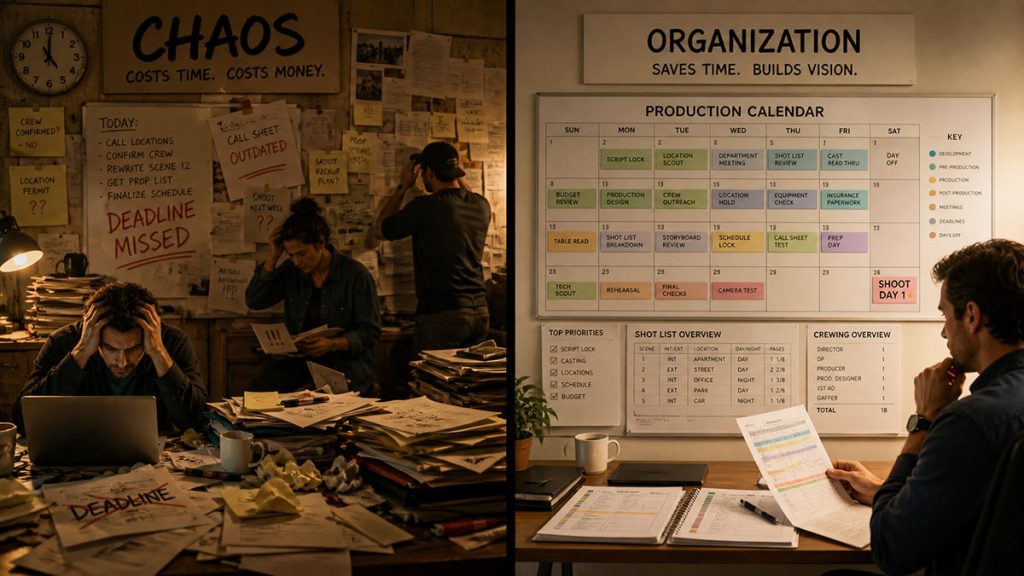
Without a calendar, these dependencies hide in the shadows.
With a calendar, they step into the light.
Production Calendar vs. Shooting Schedule
A production calendar and a shooting schedule are related, but they are not the same thing.
A production calendar shows the larger timeline of the entire production process.
A shooting schedule focuses on the order in which scenes will be filmed.
Think of the production calendar as the big map on the wall. It shows the whole campaign: prep, shoot, deadlines, rehearsals, equipment, locations, and wrap.
The shooting schedule is more specific. It tells the production which scenes are being filmed on which days, usually organized by location, cast availability, day or night scenes, company moves, and production efficiency.
For example, a production calendar might show:
- Monday: casting callbacks
- Tuesday: location scout
- Wednesday: budget meeting
- Thursday: tech scout
- Friday: final schedule review
- Week 2: rehearsals and fittings
- Week 3: principal photography begins
A shooting schedule might show:
- Day 1: Scenes 4, 7, and 9 at the apartment location
- Day 2: Scenes 12 and 14 at the diner
- Day 3: Night exterior alley sequence
- Day 4: Company move to warehouse location
The calendar creates the runway. The shooting schedule tells the plane when to take off.
See: How a Shooting Schedule Impacts Your Film Budget (And Vice Versa)
Both are important. One without the other leaves the production either beautifully planned but not shootable, or shootable but surrounded by missed deadlines, unavailable actors, unpaid permits, and the kind of paperwork fog that gives producers haunted eyes.
Why a Production Calendar Matters
A production calendar matters because film production is time-sensitive.
You are not only planning what to shoot. You are planning when people, places, equipment, money, paperwork, and creative decisions must align.
A good production calendar helps answer practical questions early:
When does the script need to be locked?
When does the budget need to be approved?
When do locations need to be secured?
When do permits need to be submitted?
When are actors available?
When does equipment need to be reserved?
When does the crew start?
When does the shooting schedule need to be final?
When do departments need final information?
These questions may not feel glamorous, but they determine whether the production has oxygen.
A director may be thinking about performances and camera movement. A producer may be thinking about contracts and budget exposure. An assistant director may be thinking about shoot days, call times, and company moves. A production designer may be thinking about when a set can be dressed. Wardrobe may need fitting dates. Locations may need insurance certificates. Camera may need gear tests.
All of these details live somewhere.
If they do not live on the production calendar, they usually live in someone’s memory, buried email thread, or rapidly multiplying sticky note colony.
That is dangerous.
A production calendar makes the timeline visible.
What Should Be Included in a Film Production Calendar?
A production calendar should be built around the real needs of the project. A short film, commercial, independent feature, web series, and studio production will all have different timelines.Still, most film production calendars include several major categories.
1. Pre-Production Dates
Pre-production is where the calendar earns its keep.
This is the period when the film is prepared before shooting begins. The team breaks down the script, builds the schedule, creates the budget, scouts locations, hires crew, casts actors, secures equipment, prepares departments, and solves as many problems as possible before they become expensive.
Important pre-production dates may include:
- Production kickoff
- Script lock deadline
- Script breakdown deadline
- Budget review
- Final budget approval
- Crew hiring deadlines
- Casting sessions
- Location scouts
- Tech scout
- Production meetings
- Department meetings
- Rehearsals
- Wardrobe fittings
- Props and set dressing deadlines
- Insurance and permit deadlines
- Equipment rental holds
- Final schedule review
This section of the calendar helps the team understand how much prep time the production really has.
That matters because under-prepared productions often pay for it during the shoot. When prep is rushed, decisions get pushed onto set. Set is the most expensive place to solve problems.
A production calendar helps move those decisions earlier, where they are cheaper, calmer, and less likely to involve fifteen people standing around waiting for an answer.
2. Script Breakdown Milestones
The script breakdown is one of the first major steps in turning a screenplay into a production plan.
See: How to Break Down a Script for Film Production (Step-by-Step Guide)
A production calendar should include the deadline for completing the script breakdown because so much depends on it. Until the script is broken down, the team may not fully understand what the project requires.
A proper breakdown identifies elements such as:
- Cast
- Background actors
- Props
- Wardrobe
- Makeup
- Hair
- Vehicles
- Animals
- Stunts
- Special effects
- Visual effects
- Set dressing
- Locations
- Special equipment
- Sound needs
- Practical effects
- Production notes
Once these elements are identified, the schedule and budget become much more accurate.
This is where screenwriters should pay attention, too. The production calendar is not only a producer’s tool. It reveals how writing choices become production requirements.
A simple line like “The street erupts into chaos” might require extras, picture vehicles, stunt coordination, police uniforms, controlled traffic, special effects, permits, and additional shoot time.
On the page, it is five words.
On the calendar, it may be two weeks of planning.
3. Scheduling Milestones
The production calendar should track when the shooting schedule is being built, reviewed, revised, and finalized.
A shooting schedule rarely appears fully formed in one perfect draft. It develops through a process.
The assistant director or scheduling team may start with a script breakdown and stripboard, then organize scenes according to locations, cast availability, day or night requirements, page count, company moves, child actor rules, stunts, equipment needs, and budget realities.
The production calendar may include dates for:
- Initial schedule draft
- Producer review
- Director review
- Cast availability review
- Location availability review
- Budget impact review
- Final shooting schedule
- Distribution of schedule to departments
These milestones help prevent the schedule from becoming a last-minute scramble.
The shooting schedule affects nearly every department. If the schedule changes, wardrobe may need different fittings. Locations may need different permits. Transportation may need different vehicles. Camera may need different gear. Production may need different crew calls. The budget may change.
A production calendar gives the team time to review those changes before they become problems.
4. Budget Deadlines
The production calendar should also include budget deadlines.
A film budget is not just a spreadsheet. It is a reflection of the schedule, creative choices, crew plan, equipment needs, locations, cast, post-production plan, and contingency.
Budgeting and scheduling are joined at the hip. They may argue sometimes, but they are walking the same road.
A production calendar can include:
- Preliminary budget deadline
- Budget review meeting
- Department budget submissions
- Final budget approval
- Vendor quote deadlines
- Insurance deadlines
- Payroll setup
- Petty cash preparation
- Purchase order deadlines
- Contingency review
Budget dates matter because producers need time to compare the creative plan against the financial reality of the project.
If the production calendar shows that the team has only two weeks before filming, but the script still requires multiple company moves, night exteriors, special effects, and a large cast, the budget conversation needs to happen immediately.

5. Casting and Actor Availability
Actor availability can shape the entire production calendar.
Even on small productions, performers may only be available on certain dates. On larger productions, cast availability can become one of the most important scheduling factors.
The production calendar may track:
- Auditions
- Callbacks
- Offers
- Contract deadlines
- Table reads
- Rehearsals
- Wardrobe fittings
- Makeup tests
- Travel dates
- Cast start dates
- Cast wrap dates
- Hold dates
- Blackout dates
This is especially important when building the shooting schedule. If one actor is only available for three days, the schedule may need to group all of that actor’s scenes together.
That choice can affect locations, crew needs, overtime risk, and budget.
For screenwriters, this is another reminder that characters are not abstract once the film enters production. Each speaking role becomes a person with dates, contracts, travel, wardrobe, makeup, meal penalties, turnaround rules, and availability.
The calendar helps the production see those realities clearly.
6. Location Deadlines
Locations can quietly become one of the most complicated parts of a production calendar.
A location is not just a place. It may involve permission, contracts, insurance, neighborhood notifications, parking, police, fire marshals, permits, power, bathrooms, weather risk, company moves, and restrictions on when the crew can shoot.
The production calendar should track:
- Location scout dates
- Director scout
- Tech scout
- Location agreements
- Permit submission dates
- Permit approval dates
- Insurance certificate deadlines
- Location prep
- Set dressing
- Strike dates
- Parking arrangements
- Location wrap
The calendar should also show location availability windows. A diner may only be available on Mondays. A school may only be available during a holiday break. A street may only be controlled overnight. A house may not allow filming after 10 p.m.
These limitations affect the shooting schedule.
They can also affect the script. If a location falls through, the team may need to rewrite, combine locations, change blocking, reduce company moves, or rethink a scene entirely.
A good production calendar does not prevent every location problem. But it gives the team a fighting chance to see them coming.
7. Department Prep
Every department needs time.
Camera needs tests.
Art needs builds and dressing.
Wardrobe needs fittings.
Makeup may need trials.
Sound may need location information.
Props need sourcing.
Stunts need planning.
Production needs paperwork.
Post may need workflow decisions before footage is shot.
A production calendar should include department prep deadlines so each team knows when decisions are due.
For example:
- Wardrobe fitting dates
- Prop approval deadlines
- Set dressing dates
- Camera test dates
- Equipment pickup
- Hair and makeup tests
- Stunt rehearsal
- Special effects test
- Production design approvals
- Sound workflow meeting
- Post-production workflow meeting
The calendar helps departments work backward from the shoot.
If a scene films on Friday, the props cannot be approved on Friday morning. If a costume is needed for a stunt, wardrobe and stunts need time to coordinate. If a location has difficult sound conditions, sound should know before the crew arrives with a call sheet and a prayer.
A production calendar gives departments the time they need to do good work.
8. Production Meetings and Communication
A calendar is only useful if the team uses it to communicate.
Production meetings are where departments share updates, flag problems, confirm details, and make sure the plan is still realistic. These meetings should appear on the production calendar, especially as the shoot approaches.
Common meetings may include:
- Kickoff meeting
- Budget meeting
- Schedule review
- Department head meeting
- Production meeting
- Safety meeting
- Tech scout
- Pre-shoot meeting
- Wrap meeting
As the shoot gets closer, communication becomes more important. Small misunderstandings can become expensive.
The production calendar helps everyone know when decisions will be discussed and when answers are expected.
A strong production calendar does not eliminate surprises, but it reduces the number of surprises wearing a fake mustache.
9. Principal Photography Dates
Principal photography is the main filming period.
On the production calendar, this section shows the shoot days, days off, travel days, company moves, and wrap dates. It may not contain the full scene-by-scene detail of the shooting schedule, but it should clearly show when filming begins and ends.
The production calendar may include:
- First day of photography
- Shoot days
- Weekends or days off
- Company moves
- Travel days
- Splinter unit dates
- Pickup days
- Final shoot day
- Wrap party or wrap date
- Equipment returns
For producers and assistant directors, this gives the full production team a clear overview of the shoot period.
For departments, it helps plan staffing, rentals, prep, and wrap responsibilities.
For the budget, it helps track the length of production, which is one of the biggest drivers of cost.
Every extra shoot day has financial consequences. Crew, equipment, locations, meals, transportation, insurance, and cast costs can all increase when the calendar expands.
The production calendar helps everyone see the cost of time.
10. Wrap and Post-Production Milestones
Some production calendars stop at wrap. Others continue into post-production.
For many independent productions, it is helpful to include at least basic post-production milestones because decisions made during production affect the edit, sound, music, color, deliverables, and release timeline.
Post-related calendar items may include:
- Media handoff
- Editor start date
- Assembly cut
- Director’s cut
- Producer review
- Picture lock
- Sound edit
- Music deadline
- Color correction
- Visual effects deadlines
- Final mix
- Deliverables
- Festival submission deadlines
- Release target
This gives the production a broader sense of the project’s life beyond the final shoot day.
A film is not finished when the camera wraps. The footage still has to become a movie.
The production calendar can help protect that process from being treated as an afterthought.
Production Calendar Example
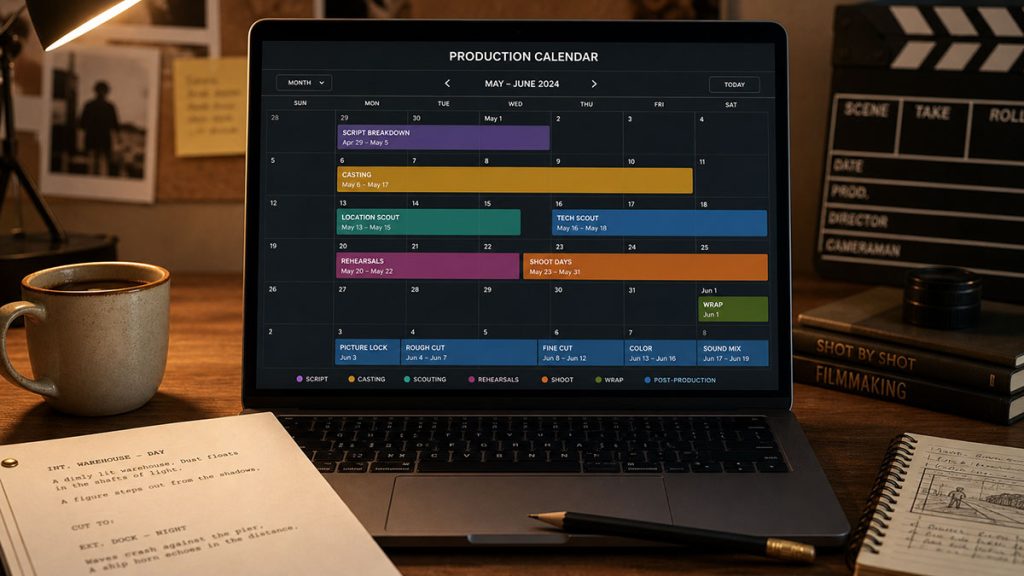
Here is a simplified example of what a production calendar might look like for a small independent film.
Week 1: Initial Prep
Script lock, script breakdown, preliminary budget, early scheduling, crew outreach.
Week 2: Locations and Casting
Location scouts, casting sessions, callbacks, department head hires, first production meeting.
Week 3: Schedule and Budget Review
Stripboard, shooting schedule draft, location holds, equipment quotes, department budget review.
Week 4: Final Prep
Tech scout, rehearsals, wardrobe fittings, props, permits, insurance, final budget approval, final shooting schedule.
Week 5: Principal Photography
Shoot days, company moves, daily call sheets, production reports, media handoff.
Week 6: Wrap and Post Handoff
Equipment returns, location wrap, final paperwork, editor handoff, post-production schedule.
This example is simple, but it shows the larger pattern.
The calendar moves from creative planning to logistical planning to execution. Each week has a purpose. Each deadline supports the next step.
Without that structure, everything tends to feel equally urgent.
With a calendar, the team can see what matters now and what is coming next.
How a Production Calendar Helps the Budget
Time is one of the biggest forces in a film budget. A production calendar helps producers understand how long the project will take and when money needs to be spent.
For example, the calendar can affect:
- How many crew days are needed
- How long equipment must be rented
- How many days locations are booked
- How many meals are required
- How long cast members are held
- When deposits are due
- When permits and insurance must be paid
- Whether overtime risks are likely
- Whether additional prep days are needed
A short calendar may seem cheaper, but if it is too compressed, it can create expensive problems. A rushed prep period can lead to bad scheduling, missed details, overtime, reshoots, or avoidable mistakes.
A longer calendar may give departments more time, but it can increase overhead and rental costs.
The goal is not simply to make the calendar shorter.
The goal is to make it realistic.
A realistic production calendar helps the budget breathe. It gives the producer and assistant director time to identify pressure points before they become expensive.
This is why scheduling and budgeting should not happen in separate rooms like distant relatives at a tense holiday dinner. They need to speak to each other constantly.
When the calendar changes, the budget may change.
When the budget changes, the calendar may need to change.
How a Production Calendar Helps the Shooting Schedule
The production calendar prepares the conditions for the shooting schedule.
If the production calendar is weak, the shooting schedule may look fine on paper but fail in practice.
For example, the shooting schedule may say the crew is filming at a warehouse on Monday. But the production calendar should confirm that:
- The location agreement is signed
- Insurance is complete
- The permit is approved
- Art department has time to dress the space
- Equipment is available
- Cast is available
- Transportation is arranged
- The tech scout happened
- Safety concerns were addressed
- Call sheets can be prepared accurately
The shooting schedule tells the crew where to go.
The production calendar makes sure the production is actually ready to go there.
This is where assistant director thinking becomes important. A good AD does not only ask, “Can we shoot this scene on that day?”
A good AD asks, “Will everything required for that day be ready?”
That question belongs on the production calendar.
How a Production Calendar Helps Screenwriters
Screenwriters do not always think about production calendars, but they should.
A production calendar reveals how writing choices create time requirements.
A script with ten locations, night exteriors, child actors, stunts, rain effects, crowd scenes, animals, and period wardrobe will require more prep than a contained drama with three locations and a small cast.
That does not mean one script is better than the other.
It means each script creates a different production reality.
When screenwriters understand production calendars, they can make smarter creative choices. They can still write ambitious material, but they become more aware of what those choices demand from the production.
For example:
A scene at a busy airport may create major logistical hurdles.
A scene in a quiet apartment may be easier to schedule.
A car chase may require stunts, permits, police, picture vehicles, and safety planning.
A tense conversation in a parked car may achieve similar story pressure with fewer moving parts.
Screenwriters who understand production do not write smaller stories by default.
They write more filmable stories.
That awareness makes them better collaborators.
Common Production Calendar Mistakes
A production calendar is only as useful as the thinking behind it. Here are common mistakes filmmakers should avoid.
Mistake 1: Treating the Calendar Like a Wish List
A calendar is not a dream board.
If dates are not realistic, the calendar becomes decorative. It may look organized, but it will not help the production.
Build the calendar around actual constraints: cast availability, location access, prep time, budget limits, department needs, and approval deadlines.
Optimism is good. Fantasy scheduling is how productions wander into the woods and return with overtime.
Mistake 2: Forgetting Department Prep
Many beginner productions focus on shoot days and forget the prep required to make those shoot days possible.
Art, wardrobe, props, camera, sound, locations, and production all need time.
If departments are not given enough prep, problems move to set. That usually costs more.
Mistake 3: Ignoring Budget Impact
Every calendar decision has a budget consequence.
Adding prep days, extending rentals, increasing shoot days, moving locations, or holding actors longer can affect cost.
The production calendar should be reviewed with the budget in mind.
Mistake 4: Not Updating the Calendar
A production calendar should not be created once and then abandoned like a cursed binder.
Productions change. Locations shift. Actors become unavailable. Permits take longer. Weather interferes. Budgets tighten.
The calendar should be updated as the production evolves.
Mistake 5: Keeping the Calendar Too Private
A production calendar is a communication tool.
Not everyone needs every detail, but department heads should have the information they need to plan properly. When people are surprised by deadlines, the calendar has failed its diplomatic mission.
Production Calendar Checklist
Before filming begins, your production calendar should answer these questions:
Has the script breakdown been completed?
Has the shooting schedule been drafted and reviewed?
Are budget deadlines clearly marked?
Are casting dates and actor availability included?
Are location scouts and permit deadlines listed?
Is the tech scout scheduled?
Are department prep deadlines visible?
Are rehearsals and fittings included?
Are production meetings scheduled?
Are equipment rental and return dates tracked?
Are shoot dates clearly marked?
Are wrap responsibilities included?
Are post-production milestones included if needed?
A good production calendar should make the project easier to understand at a glance.
It should not require a decoder ring, three producers, and a flashlight.
Where Gorilla Scheduling & Budgeting Fits In
A production calendar becomes much more powerful when it is connected to the actual production plan.
Gorilla Scheduling and Gorilla Budgeting help filmmakers move from script to schedule to budget with more clarity. Instead of treating each part of the process as separate paperwork, filmmakers can see how the creative and logistical pieces influence one another.
A script breakdown reveals what the project needs.
A schedule organizes those needs into shootable days.
A budget shows what those decisions cost.
A production checklist keeps the larger timeline visible.
That connection matters because productions are full of moving parts. When a location changes, the schedule may shift. When the schedule shifts, the budget may change. When the budget changes, creative decisions may need to be revisited.
Professional tools do not replace the producer, assistant director, or filmmaker’s judgment.
They support it.
The goal is not to make the process feel mechanical. The goal is to give the team enough structure to stay creative when the pressure rises.
A clear production calendar, supported by strong scheduling and budgeting tools, helps filmmakers plan the work before the work starts chasing them.
Final Thoughts: The Calendar Is Where the Film Becomes Real
A production calendar may not feel as exciting as a camera, a location, a performance, or a perfectly timed dolly move.
But without it, the production has no shared sense of time.
And time is where movies either come together or fall apart.
The production calendar helps turn the screenplay into a plan. It connects creative ambition to practical execution. It gives producers, assistant directors, department heads, cast, and crew a shared timeline for everything that must happen before, during, and after the shoot.
For filmmakers, it is one of the most important pre-production tools.
For screenwriters, it is a window into how the script becomes shootable.
For producers and ADs, it is the map that keeps the project moving through prep, production, and wrap without losing the plot.
A good production calendar does not guarantee a smooth shoot. No calendar can control every weather delay, actor conflict, location surprise, or mysterious production goblin that appears at 5:47 a.m. with bad news.
But it gives the team a plan.
And on a film set, a plan is not paperwork.
It is protection.
Questions or Comments?
Have a question about stripboards or film scheduling? Feel free to leave a comment below — or reach out if you want to learn more about how professional tools can streamline your workflow.